Game Design Document
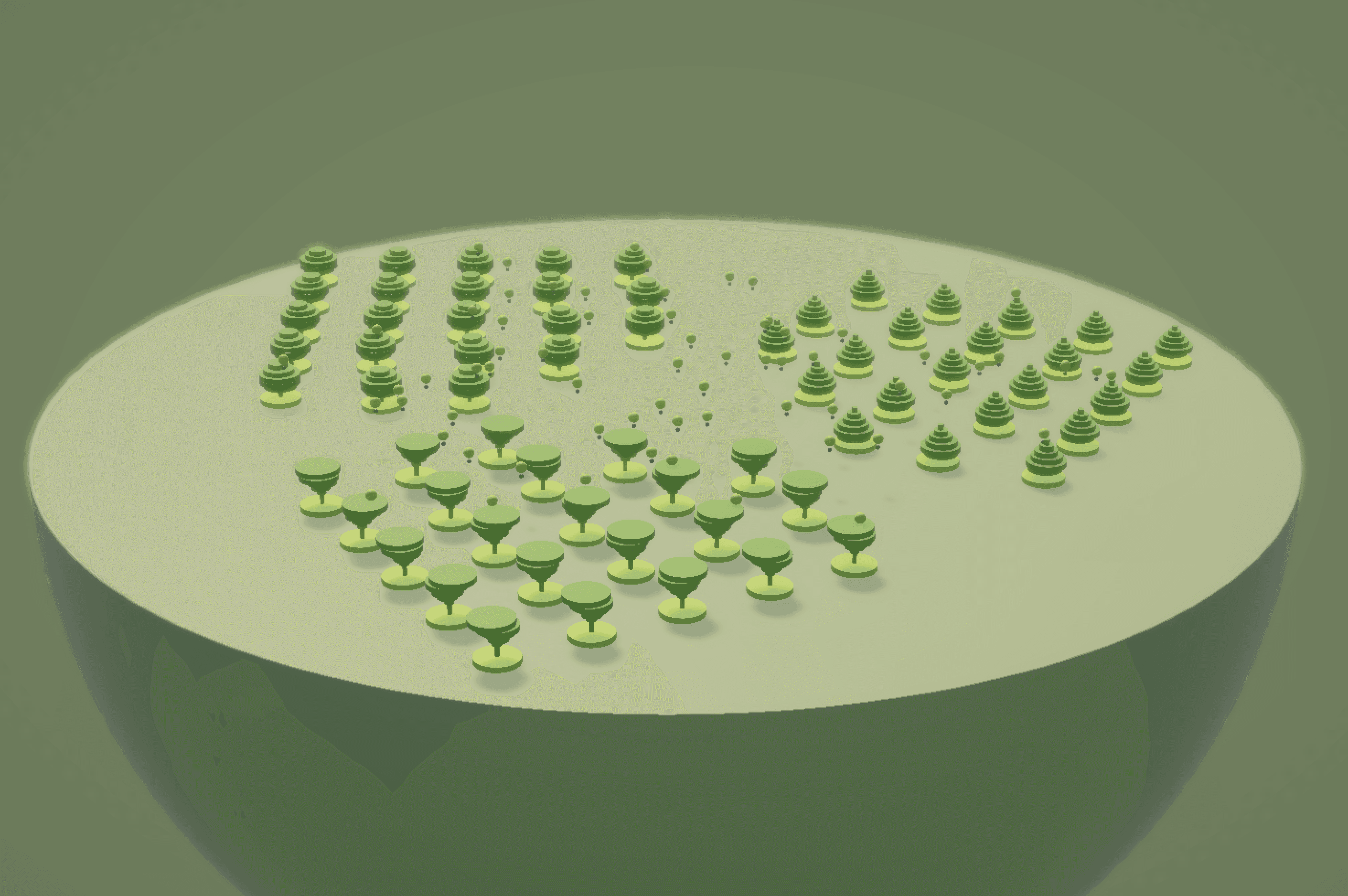
The Prototype
Game Concept
Vision & Core Idea
"Regime Shift" is a survival-based building game and an interactive metaphor for ecological balance. The game world is located on the inside of a hemisphere, whose physical tilting directly indicates how much the ecosystem has been thrown out of balance. Players act as architects of this world and must fulfill the needs of a small group of humans without destroying the delicate balance of nature.
What makes it special: Every player action leads to an actual physical weight shift in the game world. For example, when players cut down trees and transport the wood to the other side of the world to build structures there, the center of gravity of the hemisphere shifts measurably. Resources that are taken from one place are missing there as weight and reappear elsewhere – a direct, physically simulated connection between game mechanics and ecological metaphor.
The core vision is to create a symbiotic society in which humans and nature exist in harmony. If this succeeds, the hemisphere remains in balance; if the weight is disrupted too severely, the world literally tips over and the game is lost. This concept playfully illustrates the real challenges of sustainable action: only when human development and nature are in balance can the world remain stable.
Target Audience
"Regime Shift" is aimed at players who appreciate strategy, construction, and survival games with depth. The target audience includes teenagers and adults (approx. 12 years and older) who are interested in sustainability-related topics or enjoy innovative simulations. In particular, fans of games like Eco, Frostpunk, or Factorio – games that combine resource management, construction, and ecological/ethical decisions – are likely to be attracted.
Even casual players interested in an illustrative and metaphorical gaming experience can be engaged through the accessible entry point. Despite the serious topic, "Regime Shift" is primarily meant to entertain, while also encouraging reflection. The game offers enough complexity for core gamers but remains comprehensible for a broader audience through intuitive visualization (tilting world as feedback).
In educational contexts or exhibitions on environmental topics, "Regime Shift" could also find application as it playfully promotes environmental awareness – without being preachy. The balance between accessibility and depth makes it attractive for both beginners and experienced strategy gamers.
Unique Features
"Regime Shift" combines physics, ecosystem simulation, and construction gameplay in a novel way. The most important unique selling points are:
Tilting World as Metaphor
The hemisphere world that tilts according to player behavior provides direct visual and mechanical feedback. This physical balance feature is not just a gimmick but the core of the gameplay and symbolically represents the "tipping" of real ecosystems when overloaded. It gives the game a distinctive appearance and an immediately understandable indicator of success or failure.
Ecosystem Cycle & Emergence
The game world simulates a closed ecological cycle. Plants and small creatures (critters) interact in a pollination and nutrient cycle that mimics the real cycle of water or nutrients. When this cycle is disturbed, emergent problems arise: resources regenerate more slowly, certain areas become barren, and the balance shifts. Players experience ecological relationships directly through gameplay – an approach that is both educational and gameplay-engaging.
Vertical Building – Habitat Stacking
The vertical game world makes the limitation of resources spatially tangible. Instead of expanding horizontally, civilization in "Regime Shift" grows upward. Houses can be built on top of each other, with their roofs serving as new areas for planting. This creates a multi-story habitat where flora, fauna, and humans coexist layer by layer. This interweaving of nature and living space reflects concepts of modern green architecture and challenges players to creatively work with limited space.
Dynamic Balance of Growth and Collapse
The game has no static end state – the population grows when its needs are met and shrinks when there is scarcity. This creates a dynamic equilibrium. The game does not set specific goals but lets players decide for themselves how to handle this balance. Each decision (e.g., building another house vs. allowing the ecosystem to recover first) has measurable consequences, giving the game high decision significance. Players can try different strategies and experience for themselves which approaches lead to a stable world.
Theme Integration without Preaching
The central metaphor – that sustainable action keeps the world in balance – runs through all mechanics. Nevertheless, the game remains entertaining and allows players to make their own experiences, rather than delivering pre-packaged lessons. "Regime Shift" combines gameplay with ecological themes and thus offers a gaming experience that both entertains and encourages reflection.
World & Narrative
Setting
The world of "Regime Shift" takes place on the surface of a hemisphere that balances on its curved underside. This round, dish-like surface is divided into several biotopes, each housing different conditions and life forms. In the prototype, three biotope sectors are planned, dividing the surface like pie slices.
A central feature of the world is its closed cycle – what is taken from one place must be returned elsewhere for the system to remain stable. The biotopes are not isolated islands but closely interconnected: the critters move circularly across the entire surface, connecting the different habitats into a functioning overall system.
Visually, the world initially presents itself as an idyllic, untouched ecosystem. Lush greenery and buzzing critters convey a sense of abundance and harmony. This initial harmony serves as a reference state against which players will later clearly recognize changes (both positive and negative).
Background Story
The narrative starting point of "Regime Shift" is deliberately kept simple and allegorical: At the beginning of the game, a small community of humans lives in this intact but limited world. They have lived in harmony with nature until now, but over time their needs grow: When nights get cold, a simple campfire is no longer enough, and the desire for protective dwellings arises. Here the player appears as a kind of patron or planner to help the young society transition from mere survival to secured civilization.
There is no formulated, linear story or dialogue between characters – the story unfolds through the game mechanics themselves. The player's actions tell the story of humans' relationship with their environment.
At the beginning, there is a paradisiacal primordial state where resources seem abundant. But as soon as humans begin to transform nature for their progress (cutting down trees, erecting buildings), it becomes apparent how fragile this paradise is.
Over the course of a game, a dynamic narrative emerges: Perhaps a small village with stacked dwellings develops from the initially nomadic group; or thoughtless exploitation leads to an unstoppable tilting of the world and the downfall of this civilization.
Thematic Elements
"Regime Shift" is deeply rooted in the themes of ecology, sustainability, and balance:
- Ecological Balance: The central metaphor of the tilting world represents the concept of the "tipping point" in ecosystems. Small causes can have large effects – just as in the game, removing some resources can lead to the tilting of the entire landscape. The game title itself, "Regime Shift," is a term from ecology and signals this drastic change in a system state.
- Symbiosis of Humans and Nature: Rather than portraying humans and nature as adversaries, the game emphasizes the interrelationships and dependencies. Sustainable solutions in the game (e.g., green spaces on roofs or measured harvesting) symbolize real-world ideas like permaculture or circular economy.
- Resource Use vs. Conservation: A leitmotif is the fine line between use and exploitation. The game addresses questions such as: How much can be taken from the system without destroying it? Should harvesting be distributed or concentrated? When should ecosystem regeneration take priority over human needs? These questions appear in gameplay when players must decide whether to use limited resources for new construction or allow natural systems to recover.
- Growth and Limits: The vertical game world makes the limitation of resources spatially tangible. This theme reflects real discussions about endless growth on a finite planet. The necessity of building upward can be seen as a symbol of human innovation.
- Hope and Regeneration: Despite the looming dangers, "Regime Shift" also conveys a positive message: The ecosystem possesses regenerative powers, and creative solutions can enable coexistence. When players place soil on roofs and let new plants grow, the environment recovers.
All these thematic elements are made experiential through the game mechanics. This creates a coherent overall picture: The world of "Regime Shift" tells a story about the search for lasting balance between human needs and ecological stability through its design.
Game Elements
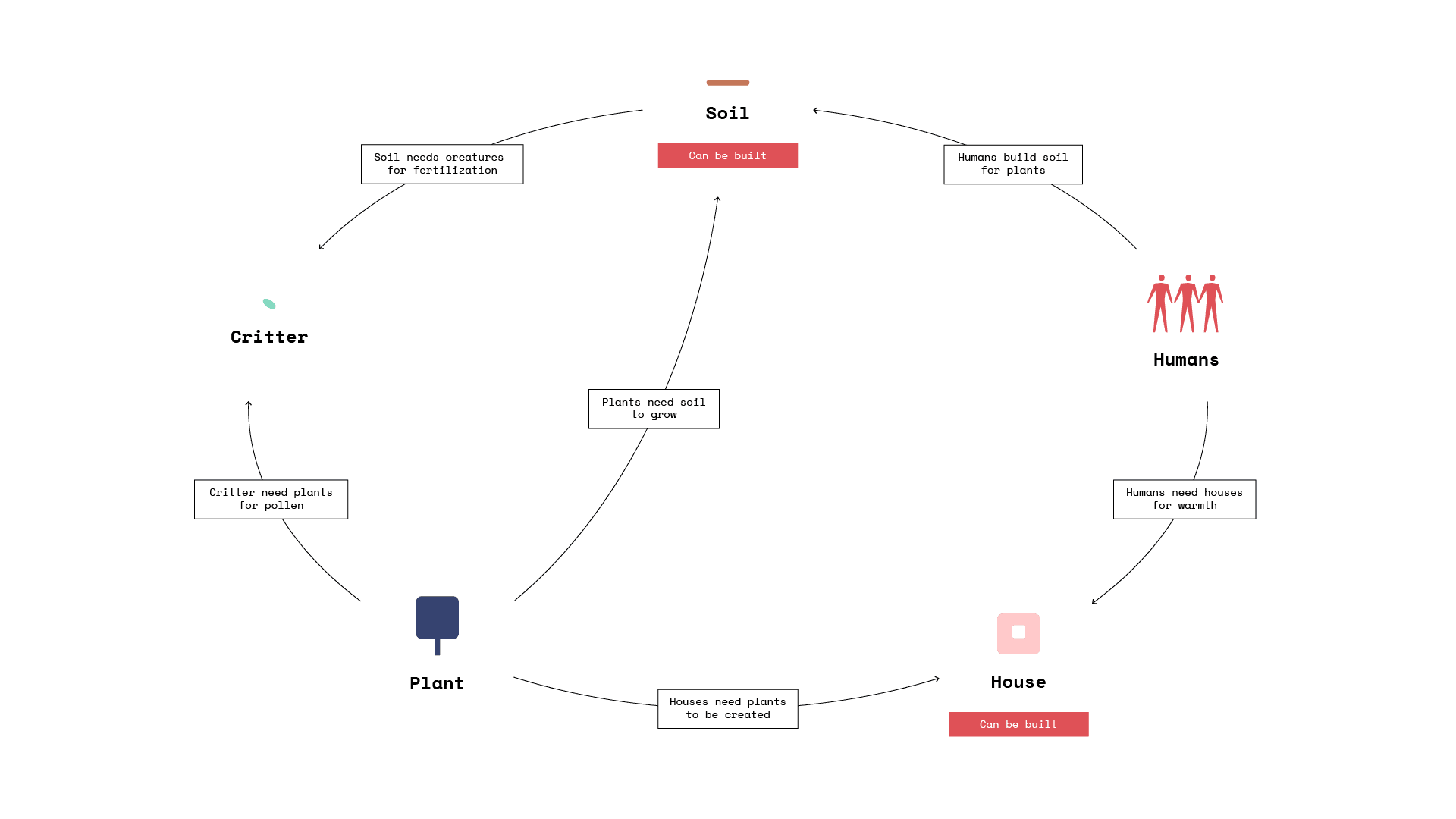
Diagram of the game objects
Critters (Flora)
Critters are small, flying creatures that represent the essential part of the ecosystem, namely the flora. They need pollen to survive and move circularly across the playing field in a fixed sequence. In their movements, they fulfill several critical functions:
- Pollination Function: Critters pollinate the ground, allowing new plants to grow. Without their pollination, the soil remains infertile.
- Dynamic Weight Distribution: Through their mass and movement, they actively influence the balance of the hemisphere. If they gather in one place (for example, because plants are missing), this can significantly disturb the equilibrium.
- Independent Unit: They cannot be harvested or used as a resource and are not directly controllable. However, they react to changes in the ecosystem.
- Indicator of System Health: Their behavior – whether uniform movement or congestion – shows the state of the ecosystem and gives the player valuable feedback.
Plants (Fauna)
Plants represent the flora of the ecosystem, form the basic sustainable resource base of the game, and are simultaneously central balance elements:
- Space-Bound Growth: Each plant requires a ground area and can only grow there. Per area, there exists a maximum of one plant.
- Resource Function: As the only harvestable resource, they provide the raw materials needed for all houses.
- Physical Presence: Each plant has a specific mass and thus contributes to the weight distribution of the hemisphere.
- Regeneration Cycle: They only grow on soils that have been previously pollinated by critters. The regeneration time varies depending on the plant species.
- Ecological Function: They produce pollen needed by the critters, completing the cycle of the ecosystem.
- Diversity: There are three different plant species in the prototype.
Humans
The human presence in the game is conceived as a collective entity:
- Social Representation: Instead of a single avatar, there are multiple humans who together represent the growing civilization.
- Autonomous Movement: The humans are controlled by a simple AI and move independently across the playing field.
- Indirect Control: The player does not control the humans directly but influences their development through building decisions.
- Dynamic Population: The number of humans grows or shrinks based on the fulfillment of their basic needs.
- Feedback Function: Through their behavior, they signal whether their needs are met or not, giving the player valuable hints.
Houses
Houses are the basic structures that are erected by the players:
- Need Satisfaction: They fulfill the basic needs of humans for protection and warmth.
- Population Growth: When sufficient houses are available, humans multiply; in case of shortage, the population decreases.
- Resource Requirement: They require certain raw materials (primarily gained from plants) for construction.
- Space Occupation: They occupy a ground area and prevent plants from regrowing there.
- Mass Factor: They have their own weight that affects the hemisphere balance.
- Stackability: They can be built on top of each other, enabling vertical growth.
- Recyclability: Can be demolished to reclaim some, but not all, of their resources.
Soil
Soil is both a natural foundation and a constructible element:
- Life Foundation: Forms the essential basis for plant growth.
- Manufacturability: Can be created through composting of harvested plant resources.
- Strategic Element: Enables the player to create new areas for plant growth.
- Vertical Dimension: Can be placed on house roofs, allowing multi-story ecosystems.
- Ecosystem Stabilizer: By creating new planting areas, balance can be restored.
- Physical Factor: Like all elements, it has a mass that contributes to the overall balance of the hemisphere.
Through the interplay of these five core elements, a complex, dynamic system emerges in which every player decision has direct and indirect impacts on the ecological and physical balance.
Player Experience
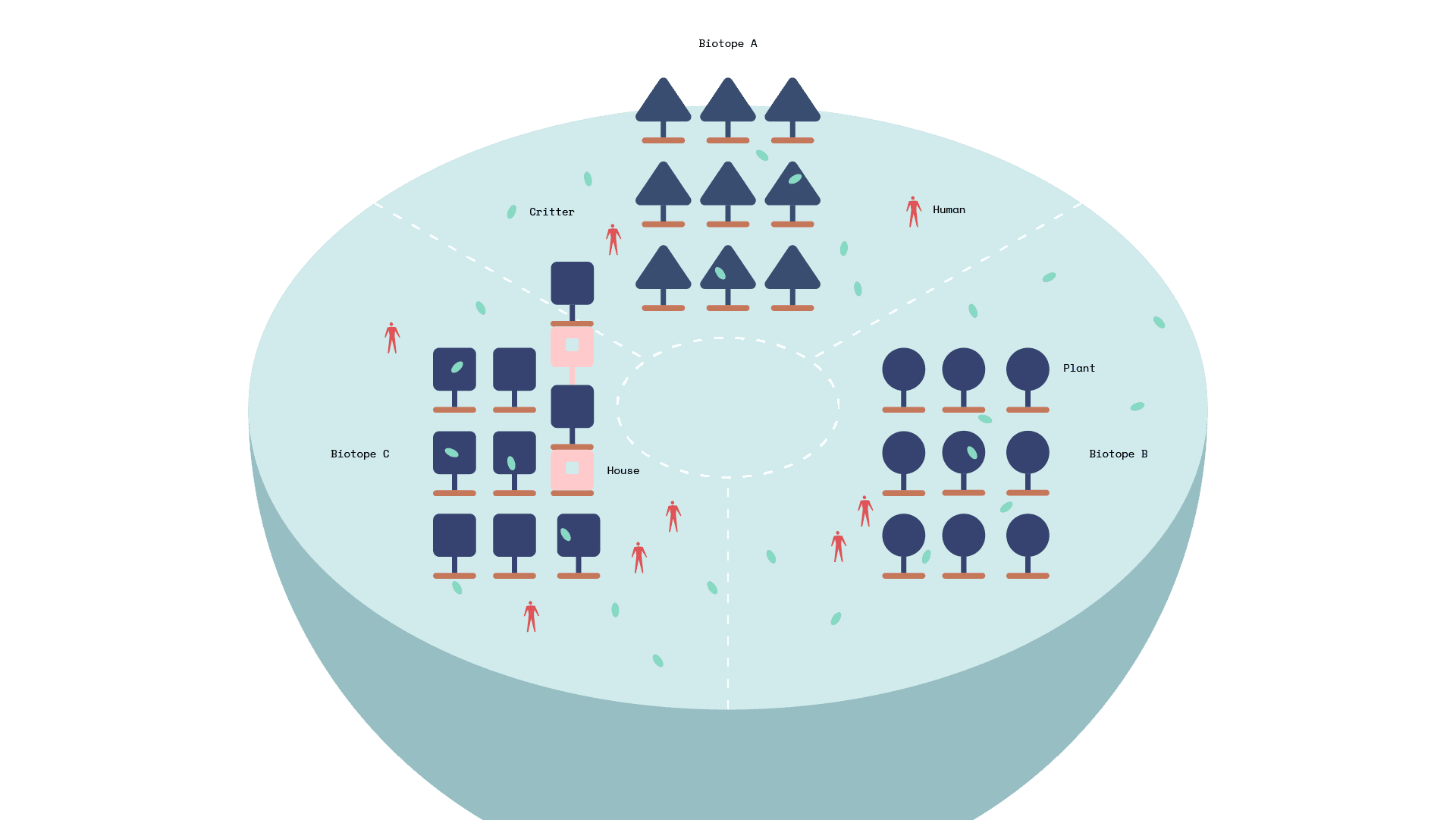
Diagram of the play area and the individual objects
Gameplay Flow
A typical game session in "Regime Shift" describes a continuous development from a harmonious natural state to a complex symbiosis between humans and environment.
Harmonious Primordial State
At the beginning, the hemisphere world presents itself in perfect balance. Plants thrive in the various biotopes, critters move in uniform cycles between them, and a small group of humans explores their surroundings. After a short time, it becomes apparent that the humans need protection from the cold. Their behavior clearly signals this need.
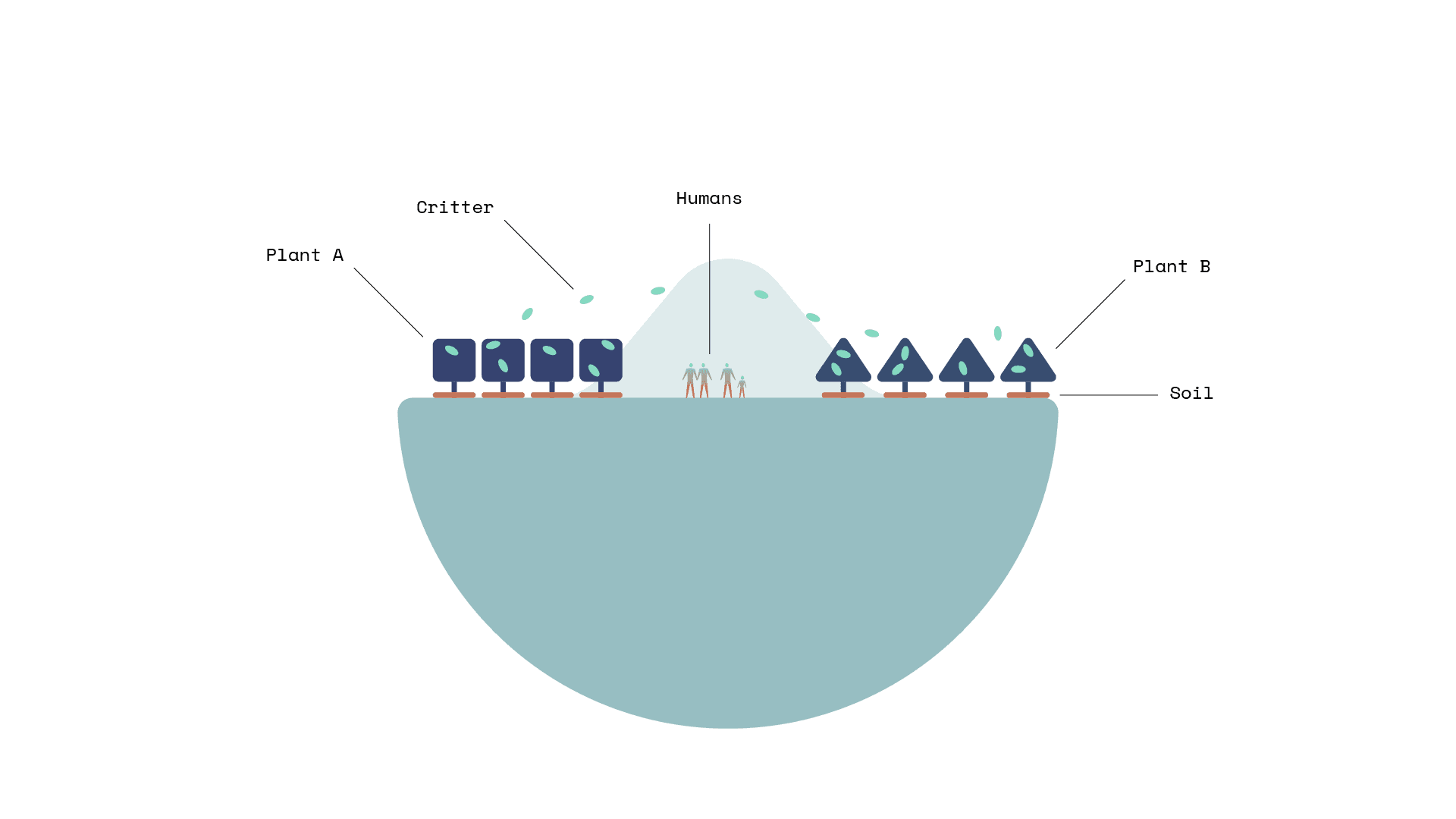
Harmonious Primordial State
First Interventions and Consequences
To meet the needs of the humans, the player decides to harvest a plant and use the obtained resources to build a house. Immediately, the first consequence becomes visible: At the spot of the removed plant, an important component of the cycle is now missing. The critters can still collect pollen from the remaining plants but must wait longer for access, leading to small congestions. This slight interruption of the cycle and the accumulation of waiting critters cause a first noticeable, but still minimal, inclination of the hemisphere.
The humans move into the new house and show satisfaction. A basic need is fulfilled, but the world has taken its first step out of perfect balance.
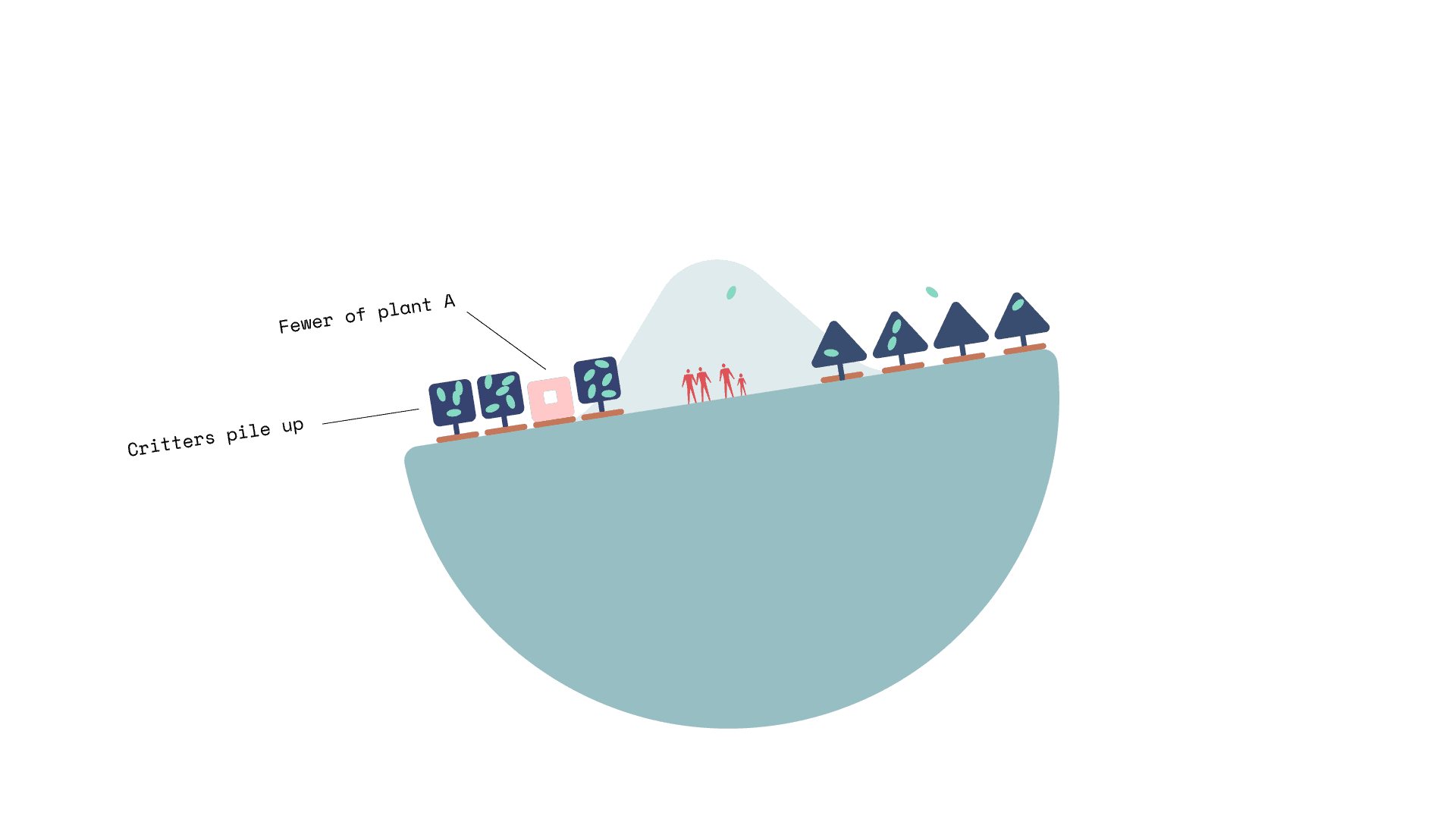
Critters gather at the diminishing plants B, the system tips over.
Stabilization of the System
After the first intervention, the player is explained that soil can be placed on existing structures, on which new plants can grow. It is up to the player to recognize that this represents an opportunity to restore the disturbed balance.
After placing the soil on the house roof, the critters pollinate the new area, and a plant begins to germinate. Over time, it grows, and the critters resume their cycle, now including the roof area in their route. The hemisphere slowly rights itself, and a new equilibrium is established – one in which humans and nature coexist.
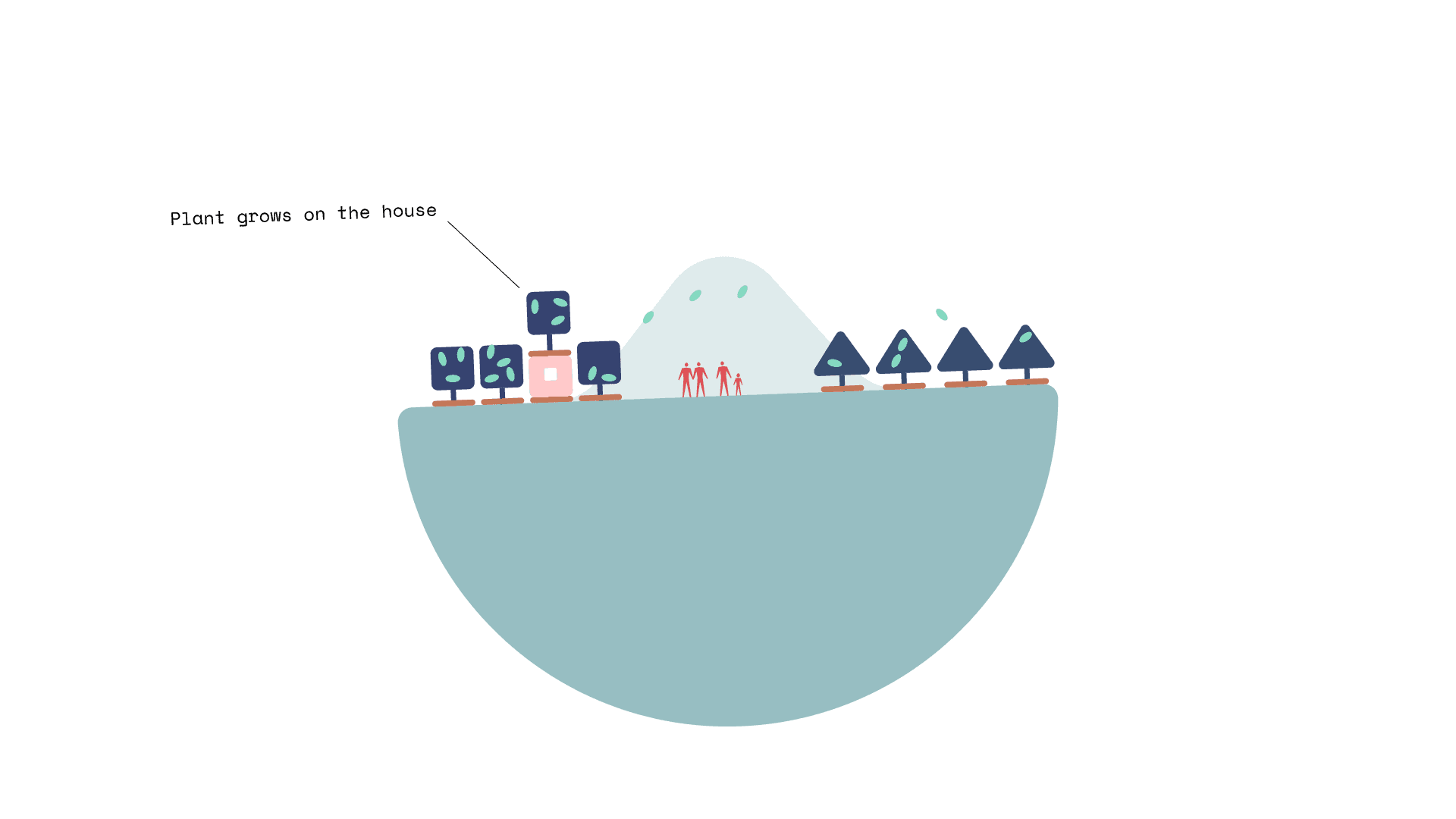
System stabilizes as the pollen shortage has been resolved
Growth and Expansion
Due to the improved living conditions, the population grows. A new child appears, and the population increases. With more humans comes a greater need for living space, which presents the player with new decisions: Where should another house be built? Which plant must give way for it?
With each new house, the balance becomes more complex. The critters now have to bridge several gaps in their cycle, and the hemisphere reacts more sensitively to changes. The player notices that the system is more complex but still manageable. After further growth cycles, the limits of horizontal expansion are reached: Almost all original ground areas are now built upon.
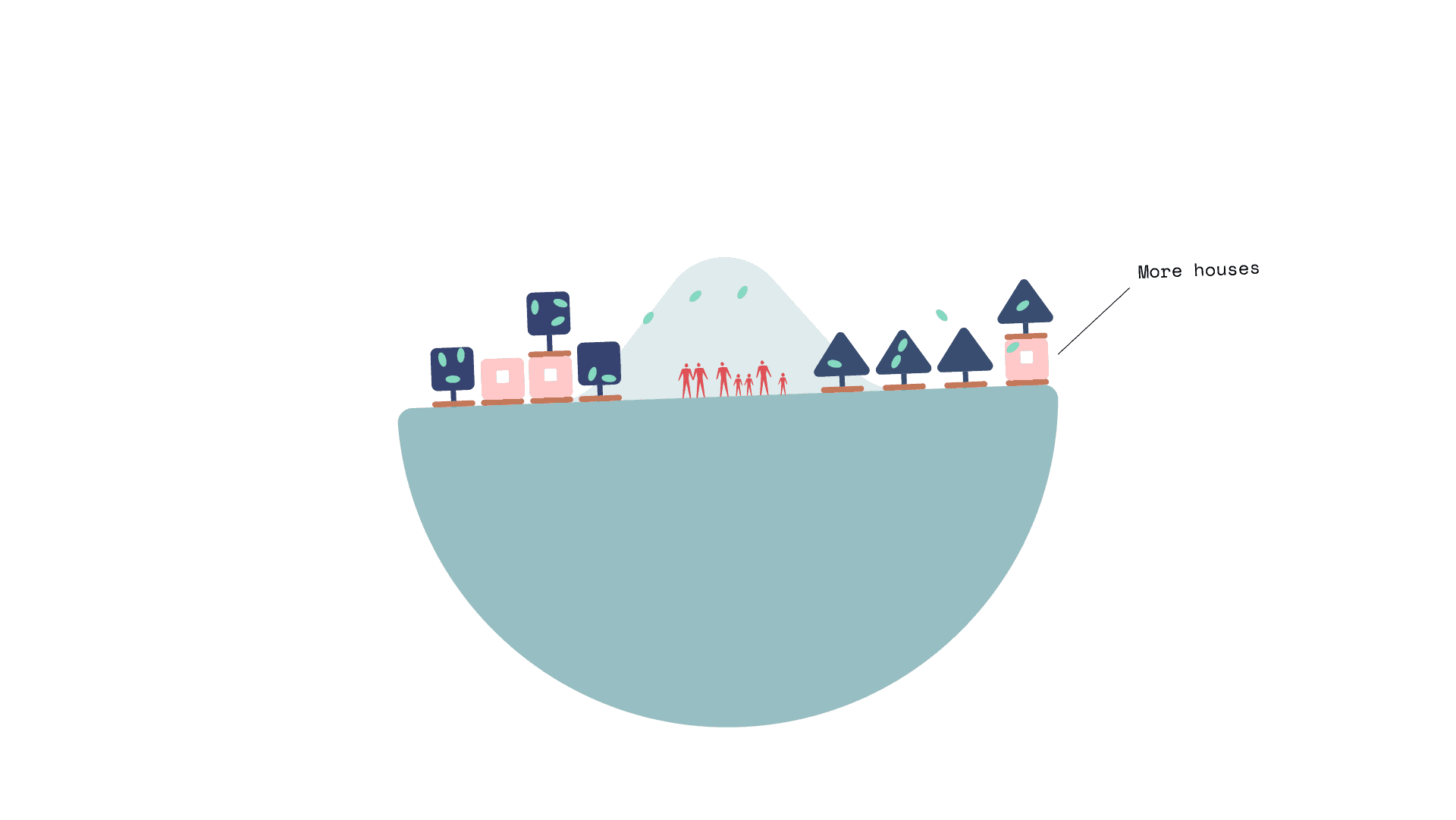
Growth and Expansion
Vertical Growth
At this point, the only way forward is upward. The player begins to build a second house on top of an already existing one. The vertical construction noticeably changes the dynamics: A multi-story tower in one biotope not only increases the load at one spot but also shifts the center of gravity upward. This combination makes the system more vulnerable to imbalances.
The higher positioning of mass can be compared to a rod balanced on a fingertip – the longer the rod, the more difficult the balance.In the game metaphor, this symbolizes the complex relationship between technological progress and ecological balance: As civilization advances, human society gains both greater impact on its natural environment and greater responsibility for its preservation. The system doesn't necessarily become more fragile, but the challenge of maintaining balance becomes more multifaceted and requires more conscious decision-making.
To counteract this, more structures must be erected in other biotopes. The management of weight distribution becomes increasingly demanding and requires both horizontal and vertical balancing.
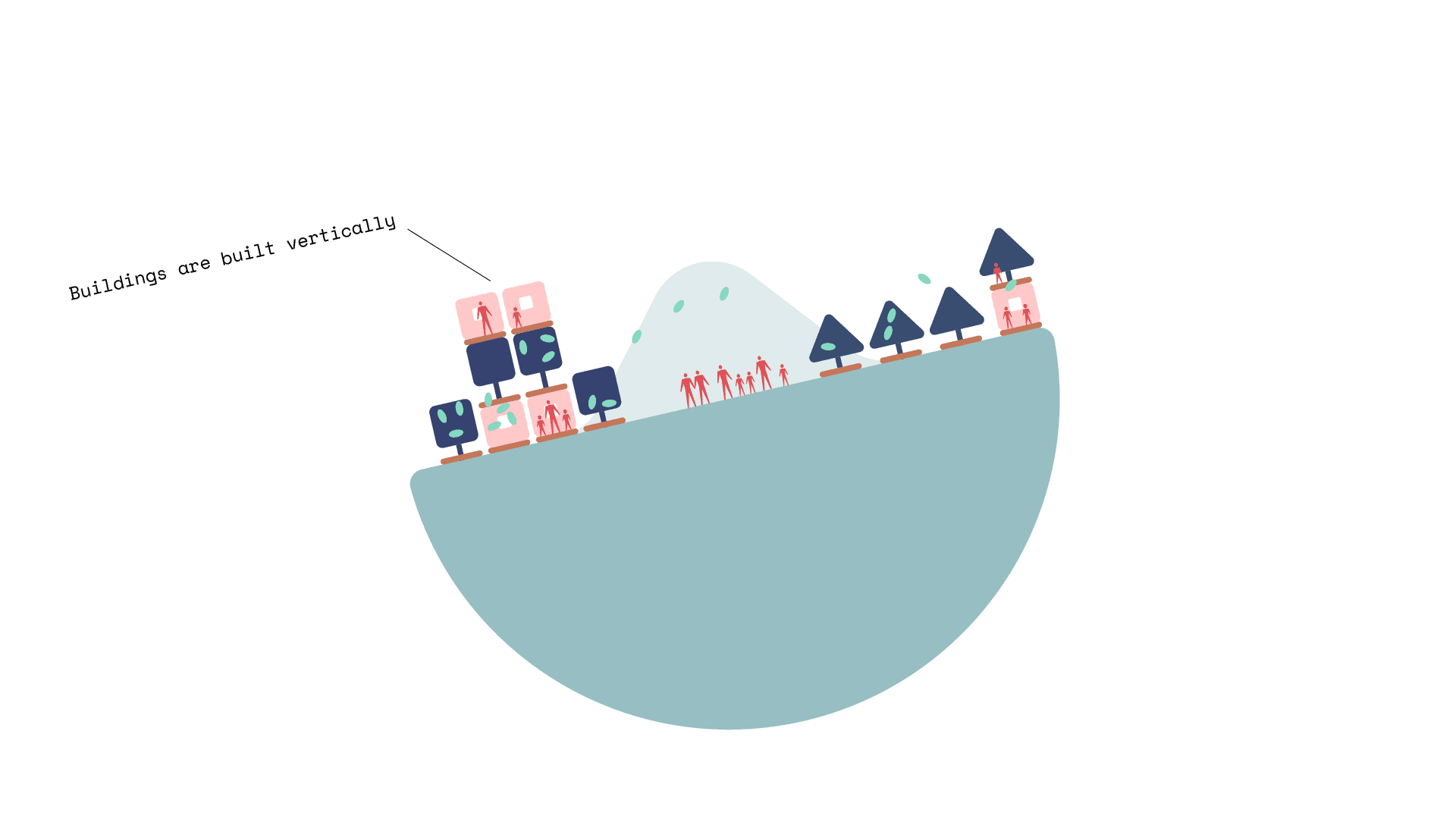
Since space is limited, building upward leads to a more unstable system
Ecosystem Complexity at Height
In the advanced game phase, the population can continue to grow or, if their needs are neglected, decrease. The player must now build multiple levels in all biotopes and constantly ensure sufficient regenerating plants.
With increasing complexity, the number of critters that must supply the growing ecosystem also increases. Their mass and movements influence the balance in turn, bringing new challenges.
With successful management, an impressive, vertically oriented settlement emerges with multiple tower structures, where humans live between plants on different levels. The critters fly in complex routes through this three-dimensional landscape. However, the system remains extremely vulnerable to balance changes – every decision could be the last.
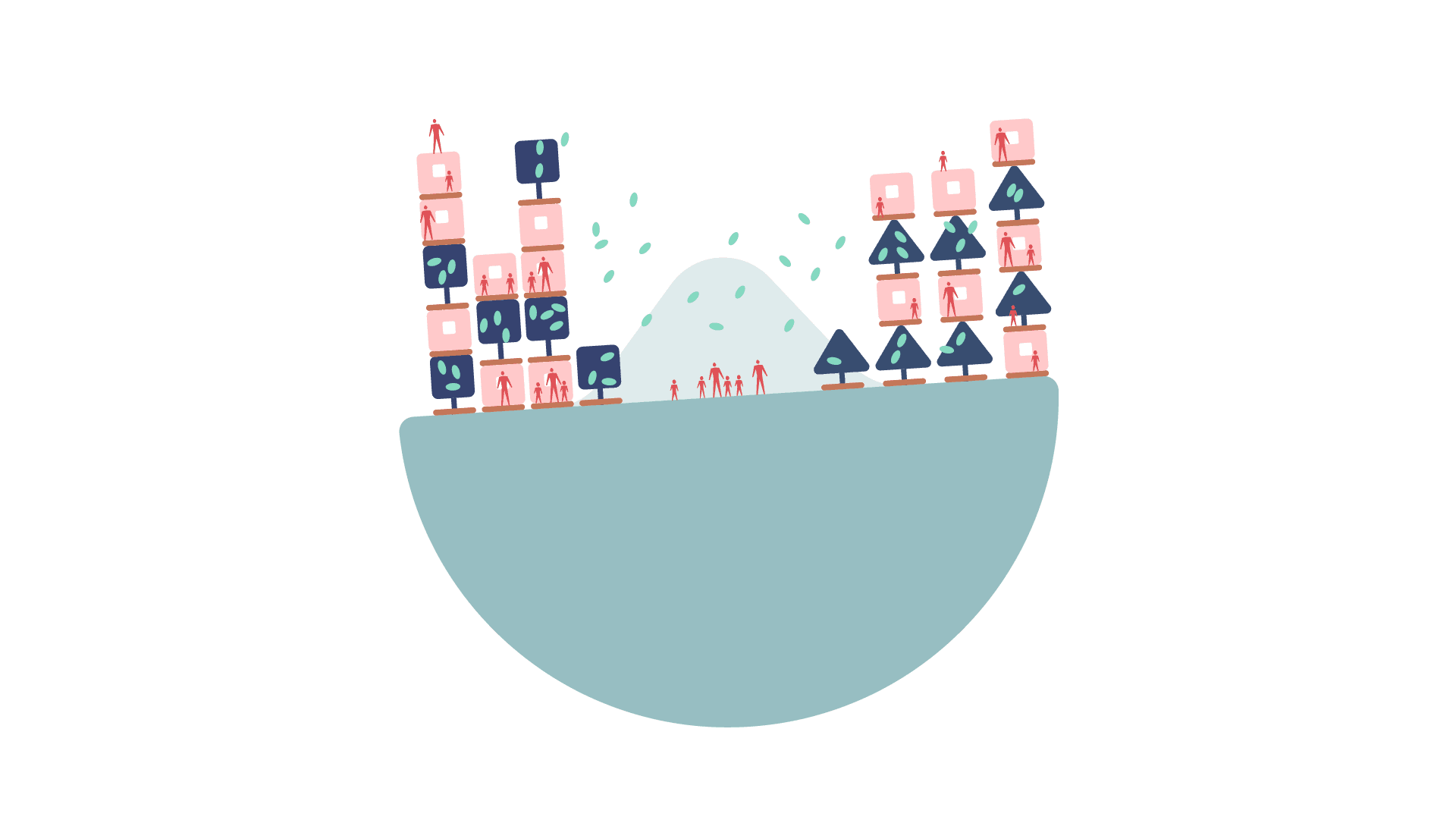
Ecosystem Complexity at Height
End Game Conditions
"Regime Shift" can conclude in two fundamentally different ways, each reflecting a distinct failure to maintain the delicate balance within the game's ecosystem:
System Collapse: The Tipping Point
The hemisphere will physically tip over when the ecosystem becomes critically imbalanced. This occurs primarily through ecological imbalance:
- When one biotope is completely depleted of resources
- When one biotope becomes disproportionately developed compared to others
This physical tipping directly mirrors the ecological concept of "regime shift" - when an ecosystem crosses a threshold and rapidly shifts to a new state. When the tipping point is reached, the hemisphere falls, and all constructed buildings tumble down, visually representing a systemic collapse.
Population Extinction
The second way the game can end is through the decline of the human population:
- When basic human needs cannot be met due to insufficient shelter, leading to population decline until extinction
As humans require houses for protection and warmth, failure to provide adequate housing will result in a decreasing population. If this decline continues and the last human dies, the game ends - even if the physical hemisphere remains balanced.
Game Duration and Challenges
A typical game session lasts approximately 30-60 minutes, depending on the player's strategy and decisions. Various performance metrics are tracked separately:
- Total time survived
- Maximum population achieved
- Number and complexity of structures built
- Balance stability maintained over time
The game also features various challenges that players can work toward completing. These optional objectives add replayability and encourage players to experiment with different approaches to ecosystem management and building strategies.
Progression and Challenges
Progression in "Regime Shift" does not follow a linear, predetermined path but emerges organically from the growing population pressure and the increasing complexity of the system:
- Basic Mechanics: At the beginning, the challenges are manageable. Harvesting a plant, building a house, and placing new soil convey the basic principles. The balance is initially forgiving.
- Resource Management: With a rising population, the resource demand grows. The player must become more strategic: When to harvest? Where to build? How long to wait for regeneration? Planning becomes more important.
- More Complex Balance: When multiple interventions happen simultaneously, the hemisphere reacts more sensitively. The player must act with foresight to avoid creating too great an imbalance.
- Vertical Dimension: Multi-story building adds a new level of complexity. The player must now think three-dimensionally and maintain balance in all spatial directions.
- Boundary Experience: In advanced game phases, the system operates at the limit of its stability. Every decision can be decisive. The player must weigh between further growth and maintaining the fragile balance.
This systemic progression allows for different play styles, from cautious-careful to risk-taking-expansive. Each failure offers learning opportunities for the next attempt.
The central player experience of "Regime Shift" combines the wonder of a reactive, living world with the joy of unusual settlement building and the thrill of the constant balancing act between growth and impending collapse.
Interface & Controls
User Interface
The user interface of "Regime Shift" follows a strictly minimalist, diegetic approach. The game world itself conveys almost all necessary information, ensuring a fully immersive gaming experience.
Diegetic Information Design
In "Regime Shift," game information is primarily communicated through the game world itself:
- Resource Availability: Visible through the number and size of available plants
- Population Status: Directly through the number of visible humans and their behavior
- System Balance: Physically experienced through the tilting of the hemisphere
- Ecosystem Health: Recognizable by the movement and distribution of critters
Classic HUD elements are deliberately avoided to emphasize the immediate connection between player actions and world reactions.
Feedback Systems
The game uses several natural channels to give the player feedback:
- Visual Feedback: The direct changes in the game world (removed plants, new buildings, visible tilting of the hemisphere) serve as the primary feedback system.
- Audio Feedback:
- Warning sounds (dull rumbling) with increasing tilt
- Resource collection signals when harvesting
- Reactions of humans (satisfaction sounds or complaints)
- Ecosystem sounds (buzzing critters in a healthy system, silence during congestions)
- Haptic Feedback: The physical tilting of the world is the strongest and most direct feedback element
Contextual Help
Minimal help appears only in situations where it is absolutely needed:
- Tooltips: Appear discreetly on longer mouse contact and disappear immediately
- Interaction Hints: Small visual markings indicate possible interaction points
Control Concept
PC Controls (Overview)
| Action | Control |
|---|---|
| Camera Movement | Right-click + Drag or A/D or Arrow keys left/right |
| Zoom | Mouse wheel or W/S or Arrow keys up/down |
| Harvest Resources | Double-click on a plant |
| Open Build Menu | Click on free area |
| Demolish Object | Select object, then choose demolition option |
| Main Menu | ESC key |
Player Interactions
The core gameplay of "Regime Shift" revolves around a few simple but powerful mechanics that directly influence the ecosystem's balance. The primary interactions that drive the game experience are:
Core Gameplay Mechanics
Resource Collection
A double-click on a plant harvests it and transfers the resource to the inventory. This basic action has significant consequences, as removing plants affects both the critters' movement patterns and the physical balance of the hemisphere. The strategic choice of which plants to harvest and from which biotopes is crucial for maintaining equilibrium.
Building
When clicking on a buildable area, a context-dependent menu appears with construction options. The game offers two fundamental building types, each serving different purposes in the ecosystem:
- Houses: These structures serve human needs by providing shelter and warmth. They require resources to build, occupy space that could otherwise support plants, and have significant weight that affects the hemisphere's balance. Houses are essential for population growth but represent a claim on natural space.
- Soil: This construction option serves nature by creating new areas for plant growth, particularly when placed on rooftops. Soil allows for vertical expansion of the ecosystem and helps restore balance by creating new habitats for plants and critters. While humans don't directly use soil, they benefit from the restored ecological balance it provides.
Demolition/Recycling
Existing structures can be removed by selection, with a portion of the resources being recovered. Buildings can only be demolished from top to bottom to maintain structural integrity. This mechanic allows players to correct imbalances or adapt to changing conditions, though at the cost of some resources.
Supporting Interactions
While not directly affecting the ecosystem balance, these additional interactions support gameplay:
Camera Control
An orbit camera allows rotation around the hemisphere and zoom to capture both details and the overall perspective. The camera is bound to the absolute world so that the tilt remains visible at all times.
Real-time Balance Preview
While selecting an object to build, its weight is temporarily applied to the selected position. The hemisphere responds with a preliminary tilt, giving the player immediate feedback on how strongly the balance would be affected before actually investing resources.
Menu Navigation
A pause menu (accessible via ESC) provides access to save game management, settings, and help.
Strategic Decision Making
The true depth of "Regime Shift" emerges from the interplay of these simple mechanics through key decisions:
- Location Choice: Where to harvest resources and where to build new structures profoundly impacts the world's balance.
- Resource Allocation: Deciding whether to use limited resources for houses (directly benefiting humans) or soil (supporting the ecosystem) creates meaningful tension between immediate needs and long-term sustainability.
- Vertical Development: As horizontal space becomes limited, players must make strategic choices about stacking structures upward and creating multi-level ecosystems.
Through these straightforward interactions, players navigate the complex relationship between human development and ecological balance, embodying the central theme of the game through their moment-to-moment decisions.
Learning Curve
The controls of "Regime Shift" are deliberately kept accessible. The world is compact, so camera navigation remains simple. The basic interactions – harvesting, building, observing – are designed intuitively so that the cognitive load stays on the actual game objective: managing the ecological balance.
The simple controls contrast with the complex simulation and allow players to focus on the consequences of their actions, not on the actions themselves.
Presentation
Visual Style
"Regime Shift" presents itself in a reduced, abstract visual style that nevertheless makes the central game elements clearly recognizable:
- Diorama Aesthetic: The game world appears like a handcrafted model on a hemisphere, similar to LEGO Builder's Journey. The hemisphere itself looks like it's made of a massive material and stands firmly on a surface.
- Abstract Representation with Recognizable Elements: Plants, humans, houses, and critters are reduced to their essential forms but clearly identifiable. Houses appear as simple geometric structures with minimal details such as window openings or flat roofs.
- Clear Color Coding: Each biotope uses a distinct, vibrant color palette, allowing players to immediately perceive different areas. The colors intensify in healthy biotopes and fade with overuse.
- Minimalist Environment: The game world stands on a simple surface in a neutral space, focusing attention entirely on the hemisphere and its inhabitants.
- Subtle Lighting: Soft light models the surfaces and emphasizes the three-dimensional quality of the world.
Animation and Physics
- Realistic Tilting Movement: The tilting of the hemisphere follows physical laws – uniform and predictable, as a physical object of this size would do.
- Stable Rooting: Structures remain firmly connected to the surface as the world tilts. Until the critical tipping point, all elements stay in place. When the tipping point is exceeded, all objects detach and fall off the hemisphere.
- Subtle Movement Animation: Plants sway slightly, critters move in uniform paths. Humans wander with simple, purposeful movements through the game world.
Audio Design
- Biotope-Specific Soundscapes: Each biotope generates its own unique soundscape. The sounds overlap at the borders and mix into a harmonious soundscape when the system is in balance.
- Critter Sound Design: The buzzing of critters functions as an acoustic indicator for the state of the ecosystem. During congestions, the buzzing becomes quieter as the critters stop their movement – this acoustic change signals problem areas.
- Reactive Music: The soundtrack reacts dynamically to the game state:
- In balance: Soothing, melodic pieces with natural instruments
- With growing instability: Increasingly dissonant elements, tension-laden rhythms
- Shortly before tipping: Reduced composition with deep, pulsating tones
- Feedback Sounds: Clear, distinct sounds accompany player actions such as harvesting plants or erecting buildings.
- Environmental Dynamics: The soundscape continuously reflects the current balance of the system.
Atmosphere & Emotions
"Regime Shift" creates an emotional journey between two poles through its audiovisual design:
- Harmony and Discovery: In phases of balance, the game conveys a feeling of wonder and security. The abstract but inviting world creates an emotional bond and awakens the desire to protect it.
- Tension and Urgency: When the balance is threatened, the atmosphere transforms noticeably. The tilting of the world, supported by visual and acoustic signals, creates genuine concern and motivates action.
The alternation between these states creates an emotional arc that deepens the gaming experience and reinforces the central message of the game: The fragile balance between human progress and ecological stability.
The abstract representation allows complex relationships to be experienced visually. The emotional component of the design ensures that the experience lingers and stays in memory even after playing.
Architecture & Frameworks
General Technical Requirements
Target Platforms
"Regime Shift" is being developed for Windows PC and macOS. The modular architecture of the Unreal Engine natively supports both platforms, ensuring a consistent gaming experience on both operating systems.
Minimum Hardware Requirements
These are based on games with comparable complexity.
Windows:
- Processor: Intel Core i5-4460 / AMD Ryzen 3 1200 or comparable
- Memory: 8 GB RAM
- Graphics: NVIDIA GeForce GTX 960 / AMD Radeon R9 380 (2 GB VRAM)
- Storage: 10 GB available space
- Operating System: Windows 10 (64-bit)
macOS:
- Processor: Intel Core i5 (2017 or newer) / Apple M1 or newer
- Memory: 8 GB RAM
- Graphics: Integrated graphics unit (Apple M1) or dedicated GPU with 2 GB VRAM
- Storage: 10 GB available space
- Operating System: macOS 11.0 (Big Sur) or newer
Used Engine and Version
"Regime Shift" is being developed with Unreal Engine 5. The choice fell on Unreal due to the powerful physics engine (Chaos), which is essential for the central game mechanic of the tilting hemisphere, as well as the flexibility in programming through the combination of Blueprints and C++.
Technical Core Concepts
Fundamental Architecture Decisions
The project follows a modular structure with clearly defined subsystems:
- Core: Basic functions, GameMode, PlayerController
- Environment: Plants, Critters, Soil, and Biotopes
- Construction: Buildings, Construction Management
- Population: Humans, Population Dynamics
- UI: User Interface
- Audio: Sound Management
The class hierarchy is based on a WorldEntity base class, from which specific entities like plants, critters, humans, and buildings are derived. This common basis facilitates the uniform handling of properties such as mass and positioning.
Central manager classes like BalanceManager, EcosystemManager, and ResourceManager orchestrate the interactions between different game elements and ensure the coherence of the overall system.
The architecture implements proven design patterns:
- MVC for the separation of data, presentation, and logic
- Observer for event-based communication
- Component-Based Design for flexible object creation
Important Subsystems
Physics Subsystem
- Use of the Chaos Physics Engine for the simulation of the tilting hemisphere
- Continuous calculation of the overall center of gravity and the resulting tilt
- Real-time preview for construction changes
AI Subsystem
- Behavior Trees for critters and humans
- NavMesh-based navigation on the curved surface
- Reactive behavior to environmental changes
Ecosystem Subsystem
- Simulation of the plant-critter cycle
- Growth and pollination mechanics
- Biotope-specific properties and states
UI Subsystem
- Minimalist, mostly diegetic interface
- Contextual menus and feedback elements
- UMG-based implementation
Data Flow Between Main Components
The information flow follows a clear scheme:
- Player inputs are interpreted by the PlayerController
- The BuildManager coordinates building actions with ResourceManager and BalanceManager
- The EcosystemManager orchestrates interactions between plants and critters
- The PopulationManager controls population dynamics and behavior
- The BalanceManager continuously monitors the balance state
- The UI system reacts to state changes and player actions
This structured interaction ensures clarity in the development process and facilitates debugging.
Tools and Asset Pipeline
For development, besides the Unreal Engine, the following main tools are used:
- Visual Studio / Xcode for C++ development
- Git for version control
- Blender for 3D modeling
- Adobe Creative Suite for UI and 2D elements
- FMOD for reactive sound design
The asset pipeline is geared toward efficiency, with clear workflows for:
- 3D assets: From concept through modeling to integration
- Audio: Creation and implementation of reactive sound elements
- UI: Design and function binding
The technical architecture of "Regime Shift" is designed to provide a flexible basis for the prototype that can be easily expanded later. The modular structure, the use of proven design patterns, and the utilization of the powerful Unreal Engine ensure a solid technical foundation for the innovative game concept.
Development Potential
This section outlines potential extensions and refinements for "Regime Shift" that could be implemented after the prototype phase. These concepts expand the game depth and strategic demands while maintaining the central metaphor of ecological balance.
Ecosystem Complexity
Extended Biotope Diversity
The current configuration with three biotopes represents the minimal approach to establish a basic balance system. This number was deliberately chosen so that no biotope directly opposes another, which would oversimplify the game principle through simple balancing.
For further development, an increase to five or six biotopes offers several advantages:
- Increased strategic depth: With more biotopes, players must develop more complex balancing strategies
- More subtle balance dynamics: The balance system becomes finer, requiring more precise player decisions
- Richer visual landscape: The hemisphere gains visual diversity and identity
The technical architecture is already prepared for this extension, as biotopes are conceived as generic, data-driven entities.
Needs Hierarchy
Extended Human Needs
In the prototype, the needs system primarily focuses on warmth and protection (houses). A natural extension would be the implementation of a more layered needs hierarchy:
- Food: Requires dedicated food growing areas or kitchens
- Community: Demands community buildings or squares
- Work: Needs workshops for crafting activities
- Education: Requires learning spaces for knowledge transfer
- Culture: Demands creative spaces for cultural expression
These needs would be unlocked gradually and could be coupled to a progression system:
- Initially, humans only strive for basic needs (protection, food)
- With the fulfillment of these basic needs, higher demands develop
- Population satisfaction and growth rate depend on the fulfillment of different need levels
This system would significantly expand the decision-making processes of players while enhancing the thematic depth of the game world.
Resource Cycles
Operation and Maintenance
A substantial extension of the resource system would be the introduction of ongoing operating costs for buildings:
- Material wear: Buildings require repair materials at regular intervals
- Operating resources: Functional buildings such as workshops continuously consume raw materials
- Lifespan: Structures could lose effectiveness without maintenance or even collapse
This system would make the resource cycle more complex and force players into more sustainable management. The decision between short-term expansion urge and long-term stability would become more significant.
Interlocked Ecosystem Dependency
With the extended resource system, the dependency on functioning ecosystems would be significantly strengthened:
- Plants provide not only building material but also essential operating resources
- Temporary overuse of a biotope can have long-term consequences
- Players must find a balance between immediate needs and ecosystem health
This mechanic would more strongly intertwine the central game metaphor – physical balance as a symbol for ecological balance – with the gameplay.
Non-Sustainable Resources
Alternative Raw Materials
An interesting extension would be the introduction of non-renewable resources such as iron, coal, or minerals:
- Basic mechanics: These resources are immediately available (not dependent on critter pollination)
- Physical properties: They are heavier than organic resources and influence the balance more strongly
- Vertical impact: Their use and placement raise the center of gravity of the hemisphere
- Strategic trade-off: Faster growth vs. stronger balance effects
The central strategic aspect of this mechanic would be the decision between:
- Rapid growth through non-sustainable resource use, but with serious impacts on the balance
- Slower, sustainable growth with more stable balance
This mechanic would draw a clear parallel to real resource decisions and increase the thematic depth of the game.
Implementation Strategy
The described extensions would not all be implemented simultaneously, but iteratively based on player tests and feedback:
- User research: Systematic analysis of player behavior with the prototype
- Prioritization: Identification of extensions with the greatest added value for the player experience
- Phased implementation: Gradual integration of extensions, starting with the most basic ones
- Continuous testing: Accompanying player tests to validate each implementation phase
- Balancing and fine-tuning: Iterative adjustment of parameters for optimal game feel
This strategic approach ensures that each extension strengthens the core vision of the game, rather than diluting it through excessive complexity.
The described extension concepts demonstrate the potential of "Regime Shift" to grow beyond the prototype into a profound, multi-layered gaming experience that combines entertainment with ecological awareness.