Documentation
Project Progression Summary
The development of ’Regime Shift’ progressed through several clear phases:
- Concept Formulation (Already established before project start)
- Defined core metaphor of tilting hemisphere as ecological balance
- Conceptual Exploration and Refinement (January)
- Defined cyclical ecosystem with Critters and Plants
- Designed hemisphere with biotope system
- Developed mechanics for ecosystem balance
- Initial Prototype Development (Late January - Early February)
- Tested physics-based tilting mechanics
- Implemented basic weight distribution system
- Validated the core physical metaphor
- System Design Development (February)
- Evolved resource system with Critters and Plants
- Created character needs and object interactions
- Established vertical building concept
- Mechanics Finalization and Tool Development (Early March)
- Refined core gameplay loops
- Integrated metaphorical elements with mechanics
- Created custom scene documentation tooling
- Defined ending conditions and player objectives
- Second Prototype Implementation (Early March)
- Developed functional ecosystem with complete cycle
- Created custom assets for plants, soil, and houses
- Implemented building and resource management systems
- Demonstrated complete gameplay loop
- Documentation (Final days)
- Created comprehensive Game Design Document
- Established foundation for continued development
Throughout this progression, the central ecological metaphor remained consistent, while the gameplay systems evolved from simple physics demonstrations to a complex, interconnected ecosystem simulation.
Starting Concept
The project began with an initial concept as outlined in the ’Concept Idea for the Orientation Project’. The core concept was already established:
- A game world located on the inside of a hemisphere
- Physical tilting as a metaphor for ecological balance
- Resource management affecting world balance
- Sustainable vs. non-sustainable resource use
This initial concept provided the metaphorical framework that would guide the entire development process. The hemisphere’s physical tilting would directly reflect ecological imbalance, creating a tangible representation of sustainability challenges.
Initial Concept Exploration
Core Questions Explored
- How will the game actually be played?
- What exactly does the player do?
- How is the metaphor maintained throughout gameplay?
- How does the gameplay support the metaphor?
- How can the metaphor be fun?
- How can emergence be used to develop complex gameplay?
- What exactly is being built?
- How is it built?
- What needs do the characters have?
- How are these needs satisfied?
- What needs does the ecosystem have?
- How can these be satisfied?
- How can characters satisfy the needs of the ecosystem?
First Solution: Ecosystem as a Cycle
The first solution was to represent the ecosystem as a cycle. Technically, the world is conceived as a voxel world with two types of resources:
- Static Resources (don’t move across the playing field)
- Trees/Wood
- Soil/Clay
- Flowers/Hay
- Dynamic Resources (move in a circular pattern across the playing field)
- Initially water, later changed to insect-like creatures called ’Critters’
In this system, static resources transform dynamic resources:
Example: Water (dynamic resource) is transformed by trees (static resource): River flows into forest → Trees absorb water and evaporate into clouds → Clouds drift to moor and rain down → Precipitation becomes fog and moves to meadow → Fog creates river → River flows into forest…
Advantages:
- Abstract representation of ecosystem as a cycle (familiar concept)
- Creates gameplay when these rules are applied:
- Player needs static resources (e.g., wood)
- Dynamic resources need static resources to be transformed
- Static resources can only transform a certain amount of dynamic resources per time
Resulting Mechanics:
- Player removes trees to build (e.g., a house)
- Fewer trees means less capacity to transform river to clouds
- Congestion occurs (flooding), more voxels in one place than elsewhere
- The hemisphere begins to tilt
This supports the metaphor by showing how removing/destroying parts of the ecosystem causes the hemisphere to tilt.
Hemisphere Design
The hemisphere was designed to be divided into three sections like pie slices. Each section would grow a specific plant species, representing a biotope. Critters would need pollen from plants in a specific sequence, requiring them to move from Plant A to Plant B to Plant C and back to Plant A, creating circular movement across the hemisphere.
When a plant is harvested, the soil becomes free and can be fertilized by a Critter for new plant growth. Plants and Critters create a circularly moving ecosystem. Houses can be built on the hemisphere but take away plant space. To regulate this, vertical building allows house roofs to be used for planting. Houses can also be built on plants, creating a multi-story habitat for fauna, flora, and humans. Biotopes remain consistent vertically - if a house is in a specific biotope, only the plant belonging to that biotope can grow on its roof.
Initial Prototype Development
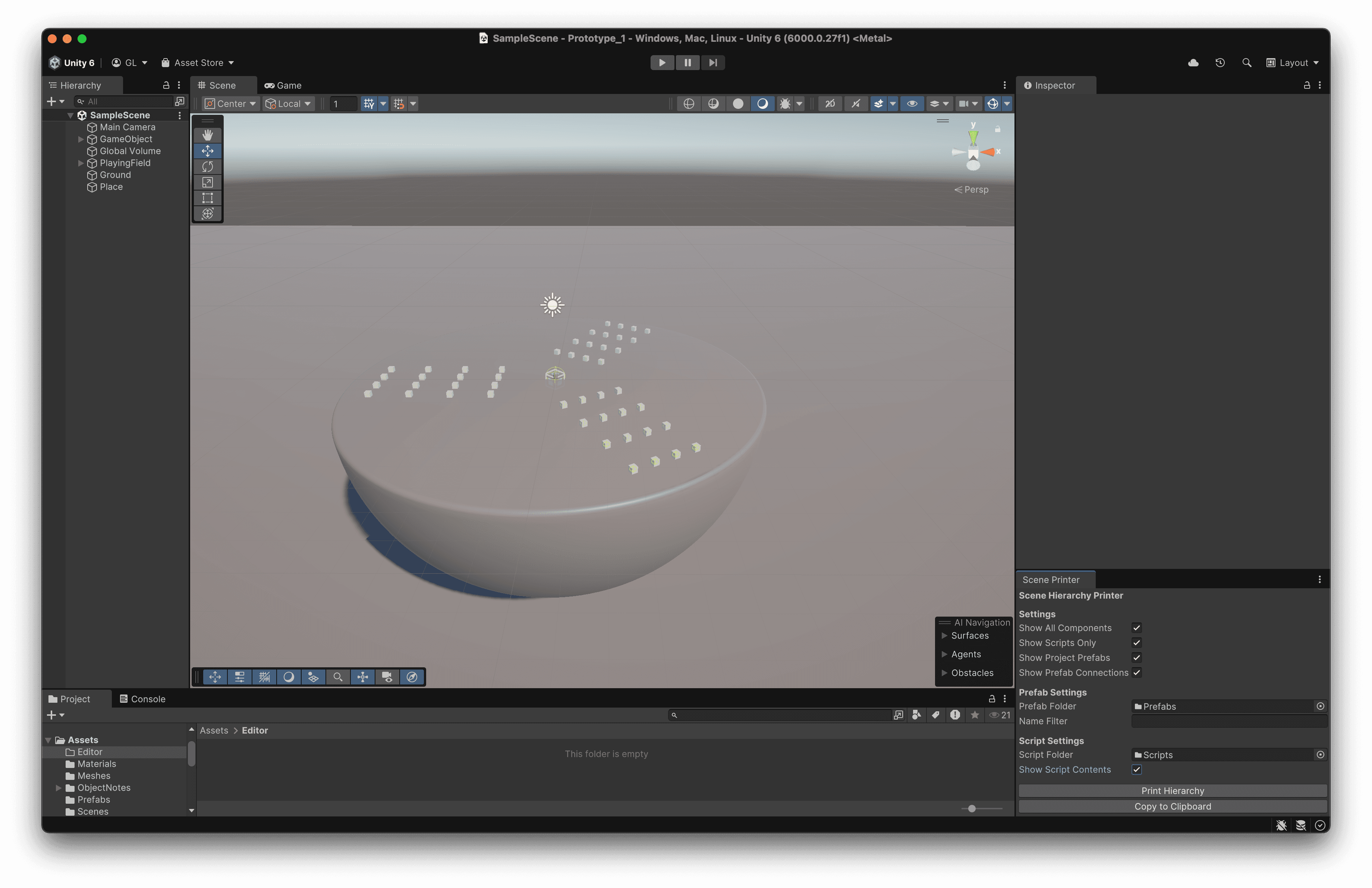
After establishing the conceptual foundation, the first prototype was developed to test the balance mechanics. This simple implementation included:
- Basic physics-based tilting hemisphere
- Resources with weight properties
- Moving entities affecting balance
- A player character that could move around
- Weight distribution affecting the hemisphere’s tilt
The scene hierarchy was structured with:
- Main Camera
- Directional Light
- PlayingField (with Rigidbody and PlayingFieldController)
- Boundary Mesh
- Ecosystem (with EcosystemController)
- Player (with movement and interaction controllers)
This prototype focused on testing whether the physical metaphor could be effectively implemented and if it created interesting gameplay dynamics.
Ecosystem Refinement
Resource System Adaptation
After consideration, I decided to replace water with bee-like insects called ’Critters’ as the dynamic resource. The static resources were changed to three different plant species living in symbiosis with the Critters.
Plant Properties:
- Grows on designated areas (one plant per area)
- Can be harvested as building material
- Has specific mass
- Regrows on designated areas
- Areas must be pollinated by Critters before plants can regrow
- Produces pollen needed by Critters (story element)
- Limited pollen production per time
- Three different plant species (initially)
Critter Properties:
- Need pollen
- Need pollen in a specific sequence, causing circular movement
- Wait at plants until pollen is available
- Have mass
- Cannot be harvested or used for building
- Fertilize empty soil so plants can regrow
- Can multiply in a Critter hive
- Domesticated Critters can transport resources for constructions
- Visually easier to implement than water, as they can simply fly without needing to create complex water flow mechanics
- Creates opportunities for rich audio feedback - when many Critters are flying, the environment hums like a vibrant meadow; when congestion occurs and fewer Critters are active, the soundscape becomes quieter
Soil Properties:
- Plants can grow on soil
- Must be fertilized by Critters
- Supports one plant per soil unit
- Can be manufactured from static resources to create new growth areas
Character System Design
Initial character concept:
- Character starts young and ages over time
- Ages slower when needs are satisfied
- Game ends when character dies
Basic Needs:
- Warmth (visible through shivering and slowed movement)
- Food (not implemented in prototype)
Object System Development
Fundamental objects:
- House
- Fulfills warmth need to a certain degree
- Requires resources to operate
- Kitchen (not relevant for prototype)
- Critter Hive
- Increases number of Critters
- Houses domesticated Critters for resource transport
- Soil
- Can be built on structures for plant growth
- Stilts
- Allows stacking structures
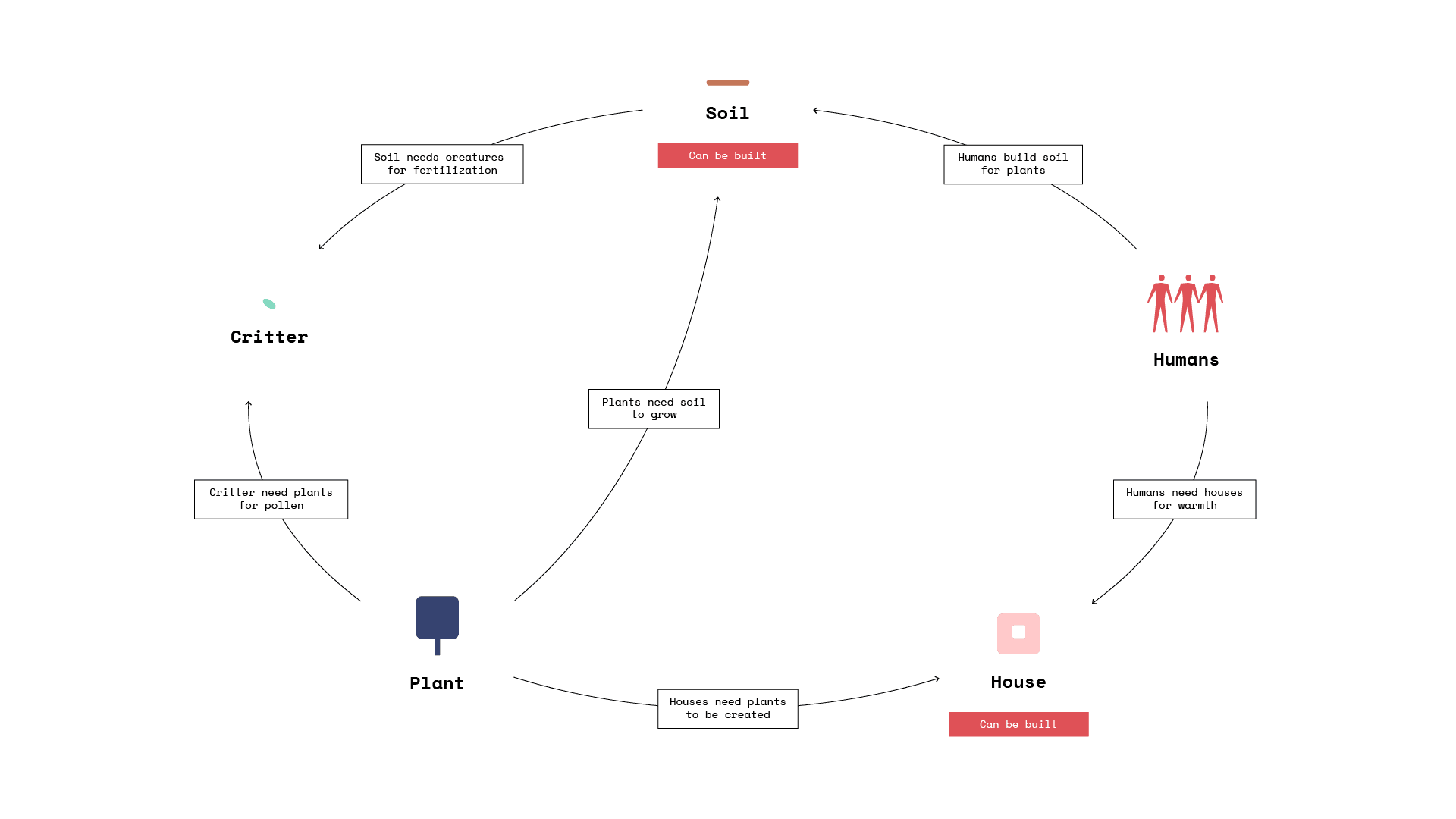
Diagram of the game objects
Concept Refinement
Feedback from Carla Heinzel provided a crucial opportunity to streamline the previous concept. Together, we defined a clear motivation for implementing the game: making the ecological metaphor playable. Using this motivation as our guiding principle, we systematically evaluated every game mechanic to ensure it served this core purpose.
Revised Game Description
At the beginning of the game, a society of humans exists in a lush landscape. Flora and fauna thrive, soil is fertile, and the world is in ecological balance. Humans live in this functioning system, but their basic needs must be met to survive. As the architect of this world, the player shapes society’s development and its impact on nature.
The world exists on the flat side of a hemisphere - a living metaphor for our ecosystem. The hemisphere’s tilt directly reflects how much the natural balance is disturbed. When the player interferes with flora and fauna to meet human needs, the effects are immediately visible in the world’s stability.
To enable sustainable development, the player must find creative ways to use limited space optimally. As the population grows, demands on the system increase. Vertical development creates new living space for humans and nature - but the higher it’s built, the more fragile the balance becomes as the center of gravity shifts upward.
’Regime Shift’ is an interactive experience of the delicate balance between human development and nature. The player becomes the designer of a symbiosis where human needs must be met in harmony with the ecosystem. The goal is to develop a stable society that exists in balance with its environment - because only when both systems are balanced can the world remain stable.
Game Mechanics Finalization
1. Congestion Mechanic
The ecosystem on the hemisphere functions as a cycle. Interrupting this cycle by removing plants creates congestion as Critters must wait to proceed. This concentrates more mass in one area, causing the hemisphere to tilt.
2. Movement Mechanic
Harvesting plants uniformly across the hemisphere avoids congestion but slows Critter movement as they wait for pollen everywhere. The ecosystem moves more slowly, regenerating more slowly as Critters take longer to fertilize soil. This eventually leads to resource depletion, unfulfilled human needs, and game loss.
3. Biotope Mechanic
The specific biotopes where plants can grow (including vertically) ensure a continuous Critter cycle and circular ecosystem movement.
4. Critter Population Mechanic
The number of Critters dynamically grows with the number of plants, ensuring fauna adapts to flora.
5. Human AI
Humans move independently across the playing field. When needs are met, they multiply; when needs aren’t met, population decreases.
6. Critter AI
Critters always seek the nearest destination. When approaching a biotope with unfertilized soil, they fertilize it first before flying to a plant to wait for pollen.
Custom Development Tool
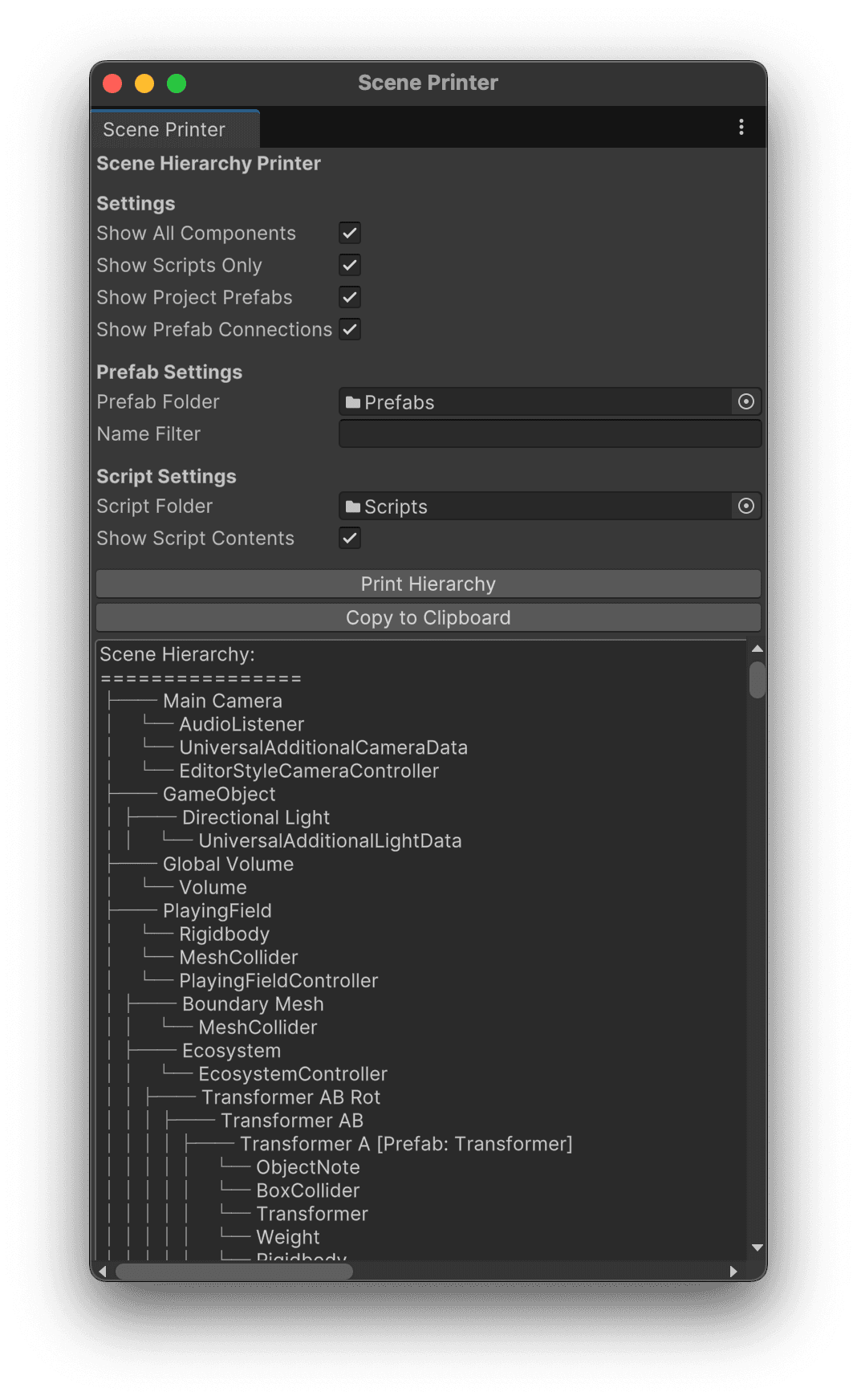
To streamline the development process, I created a custom Unity Editor tool called ’SceneHierarchyPrinter.’ This utility allows for quick export of scene hierarchies, component details, and script contents from Unity directly to text format.
The tool was specifically designed to facilitate communication with AI systems like Claude and ChatGPT, making it easier to get contextual understanding and feedback on the project structure. Key features include:
- Complete scene hierarchy visualization
- Component and script filtering options
- Prefab connection tracking
- Script content embedding
- Clipboard integration for easy sharing
This specialized tool helped me during the second prototype development phase, allowing me to quickly document complex scene structures and share them to AI assistants for technical feedback and troubleshooting.
Game Ending Conditions
The game can end in two ways:
- The hemisphere tips because the ecosystem is unbalanced
- All humans die because their needs aren’t met
At game end, statistics become viewable, including humans born and died, game duration, construction amount, and overall system stability. These statistics create basis for challenges.
This prototype had a more complex scene hierarchy, including:
- Camera system with rotation controls
- Resource management UI
- Build menu interface
- Structured environment with multiple biotopes
- Critter movement and pollination system
- Interactive towers for vertical building
Key components implemented:
BuildMenuManager: Handles UI and building interactionsEcosystemManager: Manages plants, critters, and their interactionsPollenPlant: Plants that produce pollen for crittersSoilPollination: Soil that can be pollinated to grow new plantsTower: Stackable building system for vertical growth
This prototype demonstrated the core ecosystem cycle and building mechanics, validating the central gameplay loop of harvesting resources, building structures, and maintaining ecological balance.
Second Prototype Development
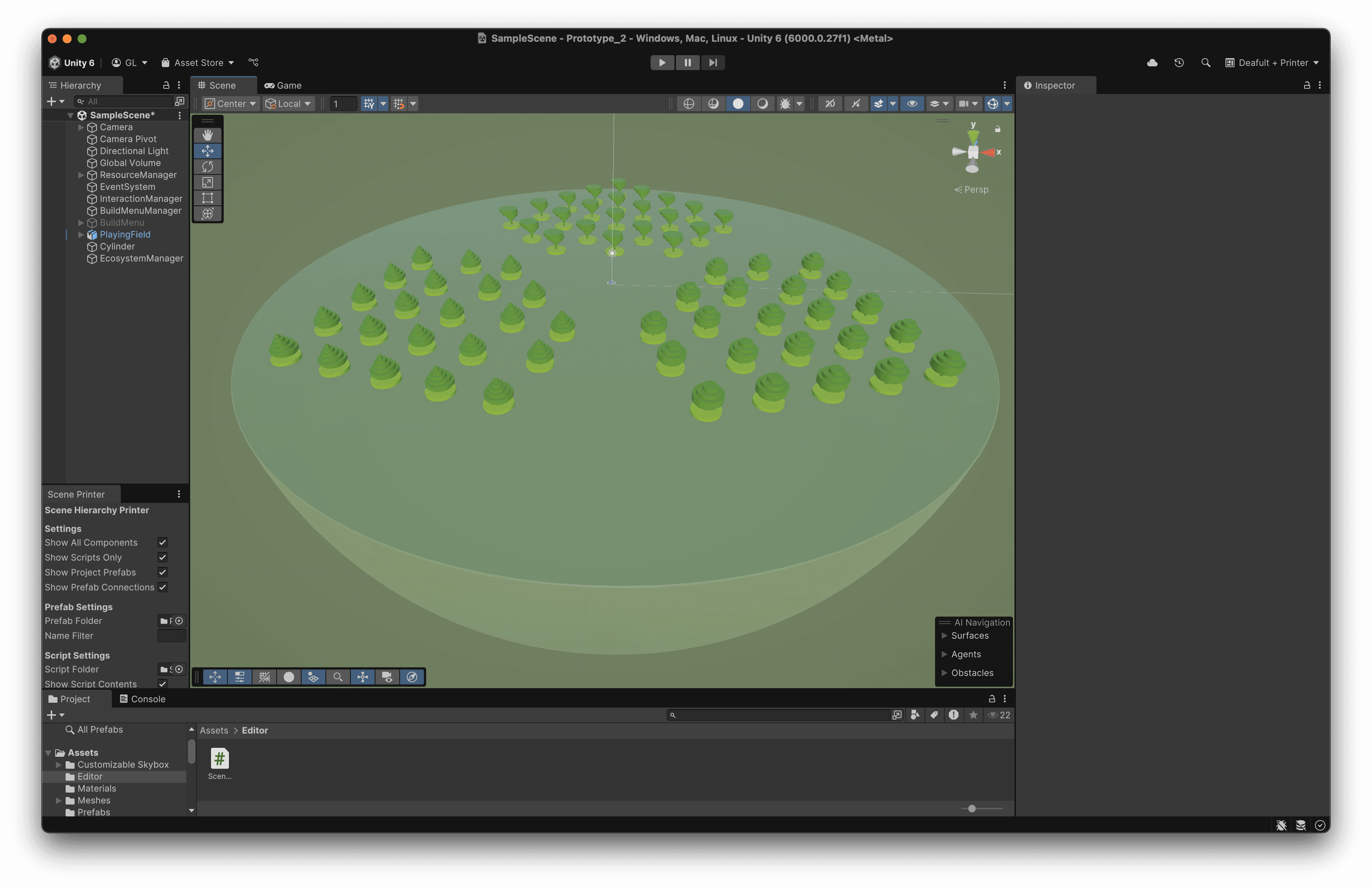
Based on the refined concept, a second, more sophisticated prototype was developed. This prototype was designed to test:
- The biotope system with three distinct types (A, B, C)
- Plant/critter cycle mechanics
- Building systems (houses and soil)
- Resource gathering and management
For this prototype, I created custom assets including:
- Soil
- House
- Plant1, Plant2, and Plant3 (one for each biotope type)
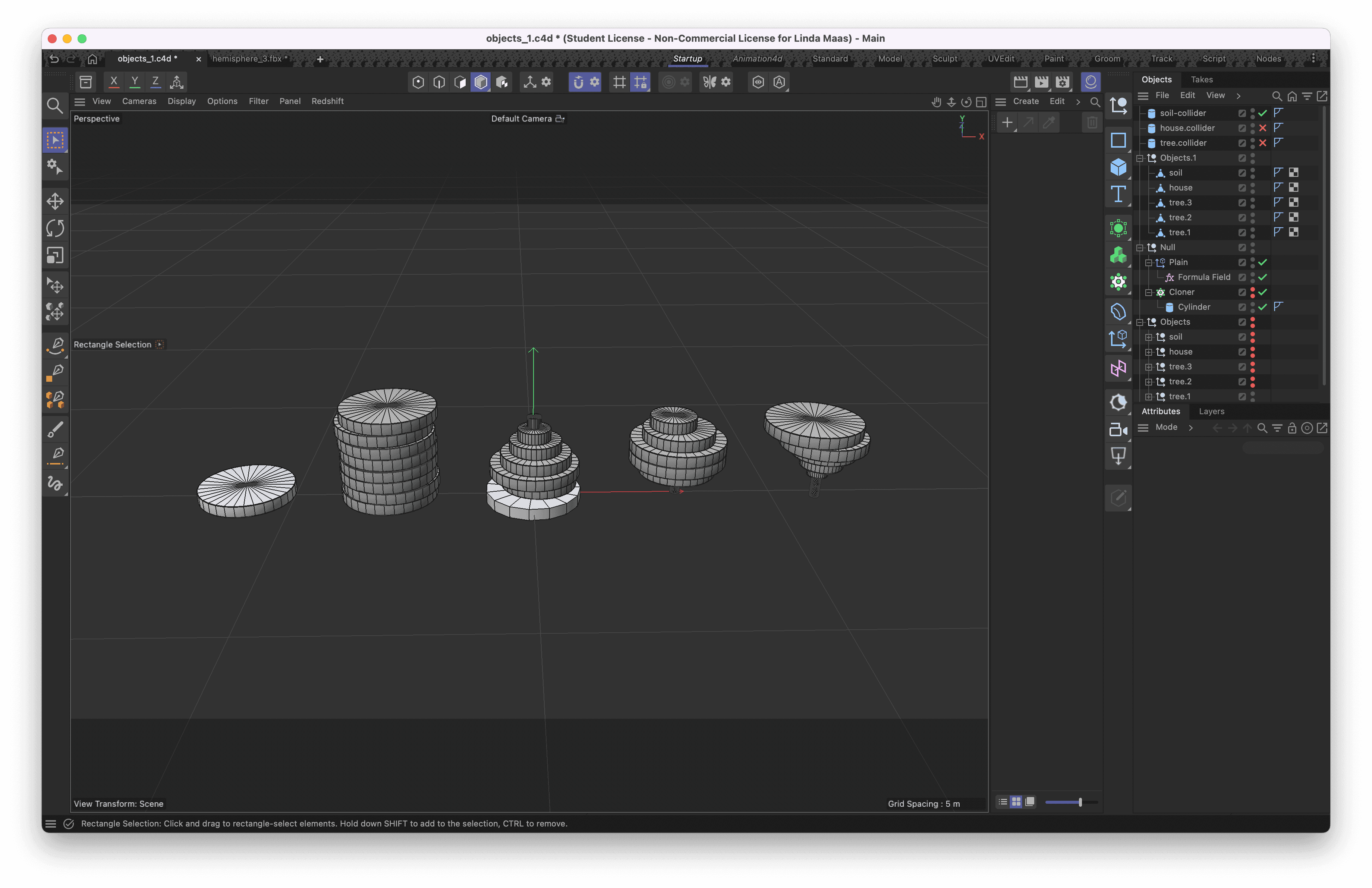
These custom-designed assets helped visualize the different biotope elements and allowed for clearer distinction between the plant types in each ecosystem zone.
Final Documentation and Game Design Document
As the culmination of the project, a comprehensive Game Design Document was created to formalize the concepts developed throughout the process. This document:
- Articulates the complete vision of ’Regime Shift’
- Defines all game elements and their interactions in detail
- Outlines the metaphorical relationship between gameplay and ecological themes
- Specifies technical requirements and architecture
- Maps potential for future development
The GDD synthesizes all insights gained from the conceptual exploration and prototype development, providing a solid foundation for future development beyond this initial phase.
Project Assessment and Reflection
Overall, I believe the project didn’t fully achieve its intended goals. This assessment was confirmed by feedback from Carla Heinzel, who suggested I should look for a different metaphor since the gameplay feels like ’a workaround to make the metaphor function.’ I understand this criticism as I feel the same way about certain aspects of the project.
The core problem lies in the fact that we’re playing with a ’real ecosystem’ of flora and fauna while using it to benefit humans. However, the metaphor focuses on weight distribution, which doesn’t naturally align with how ecosystems function. This creates a gap where we must find ways to preserve the metaphor while keeping the ecosystem playable. While this works to some extent, it relies more on workarounds than on a thoroughly conceived concept.
Another challenge identified during this process relates to funding opportunities for game development. I found that most grant programs for games require developers to cover 50% of the costs themselves, which creates a significant barrier to entry for independent developers. A more accessible model would follow the Prototype Fund approach, which provides a set investment amount upfront to kickstart development without requiring matching funds. This financial aspect is an important consideration for the project’s future development beyond the prototype phase.
In my assessment, the metaphor itself functions well, but the gameplay mechanics surrounding the ecosystem don’t quite reach the same level of cohesion and intuitive design.
Learnings and Technical Development
This project provided valuable learning experiences across multiple dimensions of game development:
Programming in C
Working with C# proved to be a particularly enjoyable experience. Unlike TypeScript, where types themselves often become problematic, C#’s integrated type system felt natural and streamlined the development process. The strong typing helped catch errors early in development, reducing debugging time and improving code reliability.
Design Patterns and Architecture
The project allowed me to experiment with various programming patterns, most notably:
- Event systems for decoupled communication between components
- Unity’s component-based architecture for modular design
- Dependency management between different game systems
Understanding which components should depend on others and how they should communicate required careful planning, especially when designing the ecosystem interactions between plants, critters, and the environment.
Unity Development
Unity’s development environment proved remarkably efficient for rapid prototyping. The ability to quickly test ideas, modify components, and visualize changes in real-time accelerated the development process. The visual editor combined with programmatic control created a powerful workflow for implementing and refining game mechanics.
Game System Design
Designing interconnected game systems presented unique challenges, particularly when balancing complexity with playability. The process of translating conceptual ideas into functioning mechanics required multiple iterations and rethinking of approaches.
Future Development Approach
For future projects, I would focus on creating more streamlined game systems with simpler, more intuitive mechanics. I’ve learned that a well-executed simple system can be just as engaging and meaningful as a complex one, while being easier to implement and refine. Reducing scope and focusing on core gameplay experiences would likely yield better results within similar time constraints.
Reflection on Development Goals and Timeline
Minimal Viable Product vs. Best-Case Scenario
Looking back at my initial goals for the project, I believe I achieved something closer to the Minimal Viable Product (MVP) rather than the best-case scenario I had initially envisioned. The reasons for this are largely outlined in the Project Assessment and Reflection section above.
From a technical perspective, I accomplished my learning objectives related to Unity and C# development. I’ve reached a point where I can accurately assess what is feasible to implement within Unity given specific time constraints. The experience has provided valuable insights into the development pipeline and resource requirements for different game features.
Conceptually, I developed the game idea as thoroughly as possible given the constraints. The core metaphor and gameplay mechanics were fully defined, even if the integration between them wasn’t as seamless as desired. The prototype demonstrates the fundamental concepts, though it would require further refinement to achieve the best-case scenario originally planned.
Original Work Plan and Timeline
Throughout the development process, I made several adjustments to my original work plan based on emerging circumstances and discoveries. I spent more time on conceptual development than initially planned, as I continued searching for a more elegant solution to integrate the ecological metaphor with engaging gameplay. This extended concept phase was a deliberate choice, as I believed that finding the right conceptual foundation was crucial for the project’s success.
While the technical implementation progressed relatively smoothly, the conceptual challenges required more exploration and refinement than anticipated. These adjustments were necessary to ensure that at least a minimal viable product with a coherent conceptual framework could be completed within the project timeframe.
Despite these adjustments, the core milestones were maintained, though their scope and implementation details evolved throughout the process. This flexibility was essential for adapting to technical constraints and conceptual refinements that emerged during development.