Regime Shift
An Interactive Metaphor for Ecological Balance
Project Overview
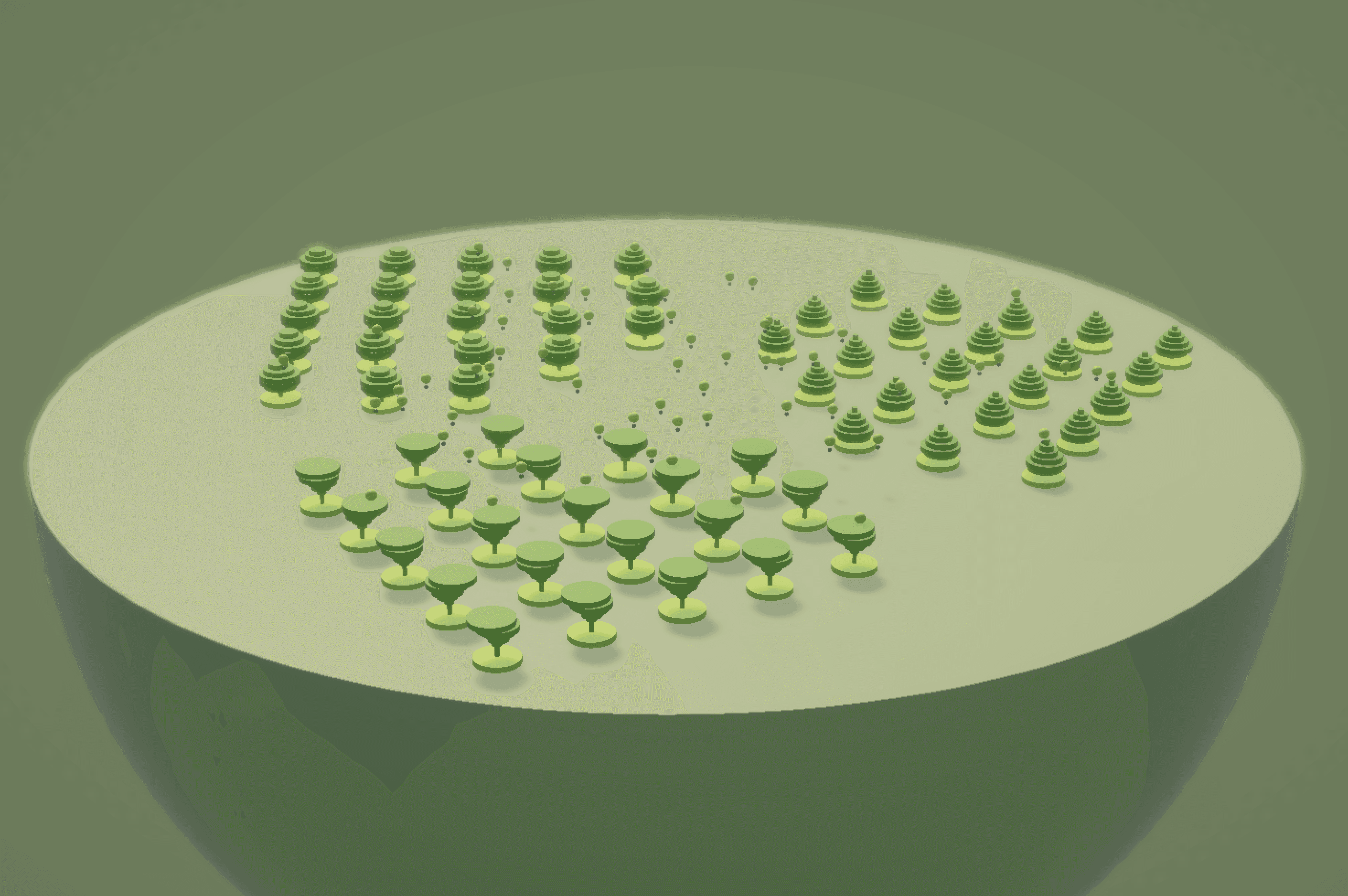
Regime Shift is a survival-based building game that serves as an interactive metaphor for ecological balance. Set on the flat, enclosed top surface of a hemisphere, the game world physically tilts in response to player actions, directly visualizing ecological imbalance. As players fulfill the needs of a small human settlement, they must carefully manage resources to prevent the world from literally tipping over.
Core Gameplay: Players act as architects of this miniature world, making decisions that affect both human prosperity and environmental stability. Every action—from harvesting plants to constructing buildings—shifts the center of gravity, creating an immediate physical representation of ecological impact.
The Challenge: Create a symbiotic society where humans and nature exist in harmony. When successful, the hemisphere remains balanced; when the ecosystem is disrupted too severely, the world tips over and the game is lost.
Project Documentation
The complete documentation explores the conceptual and technical development of Regime Shift from initial idea to prototype. It details the design philosophy behind the ecological metaphor, the evolution of gameplay systems, and the challenges encountered during implementation. For those interested in the creative process or technical aspects of game development, the documentation provides valuable insights into both the successes and limitations of the project.
Game Design Document
The comprehensive Game Design Document (GDD) was a key deliverable of this project, detailing the complete vision and mechanics of Regime Shift. It outlines the game’s concept, target audience, unique features, and technical requirements – elements essential for funding applications in the games industry. The GDD serves as a blueprint that would guide further development, providing potential investors with a clear understanding of the project’s scope, goals, and market potential. For anyone interested in game development funding processes, this document demonstrates the level of planning required for successful grant applications.
Technical Implementation
Core Systems
Regime Shift was developed in Unity using C#, with a focus on creating interconnected systems that represent a functioning ecosystem:
- Physics-Based Balance Mechanism
- The hemisphere uses Unity’s physics system to calculate real-time weight distribution
- Each entity (plants, buildings, critters) has a specific mass affecting the world’s equilibrium
- Custom center-of-gravity calculations determine tilt angle and direction
- Ecosystem Simulation
- Circular resource flow between three distinct biotopes
- Plant-critter symbiosis with pollination and growth cycles
- Emergent behavior from simple rule sets
- Vertical Building System
- Multi-story construction with structural dependencies
- Rooftop soil placement for vertical ecosystem expansion
- Weight management that becomes more complex as structures grow taller
- Character Needs and Population System
- Basic need fulfillment affecting population growth
- Autonomous movement and behavior based on simple AI
- Dynamic response to environmental changes
Development Tools
Custom tools were created to support the development process:
- SceneHierarchyPrinter: A specialized Unity Editor tool for documentation and sharing scene structures
- Custom asset creation pipeline for plants, soil, and building elements
- In-editor visualization tools for balance and weight distribution
Development Timeline
The project progressed through several distinct phases:
- Concept Formulation (pre-January 2025)
- Conceptual Exploration (January 2025)
- Initial Prototype (Late January - Early February 2025)
- System Design Refinement (February 2025)
- Mechanics Finalization (Early March 2025)
- Second Prototype Implementation (Early March 2025)
- Documentation (March 2025)
Context & Related Work
Regime Shift sits at the intersection of several gaming traditions and ecological concepts:
Ecological Concepts
- Tipping Points: The game visualizes the ecological concept of ’regime shifts,’ where ecosystems cross thresholds and rapidly transition to new states
- Ecosystem Services: The symbiotic relationship between plants, critters, and humans reflects the interdependence of real ecological systems
- Carrying Capacity: Limited space forces players to consider the maximum sustainable population
Gaming Influences
- Resource Management Sims: Like games such as Frostpunk and Factorio, Regime Shift challenges players to balance resource extraction with sustainability
- Eco: Similar to Eco, the game illustrates how individual actions affect a shared environment
- Building Games: Vertical construction elements draw inspiration from city-builders while adding ecological considerations
Innovation
What sets Regime Shift apart is its direct physical manifestation of ecological imbalance. While many games address environmental themes, few create such a tangible connection between player actions and environmental consequences. The tilting hemisphere serves as both gameplay mechanic and metaphor, making abstract ecological concepts immediately perceptible.
Results
Two functional prototypes were developed during this project:
First Prototype
Controls:
| Key | Action |
|---|---|
| W, A, S, D | Move player character |
| E | Collect resources |
| Mouse Scroll | Zoom in/out |
Initial Physics Test
The first prototype focused on validating the core physical metaphor. It featured:
- Basic physics-based hemisphere tilting
- Weight distribution system
- Simple player movement
- Rudimentary resource entities
This prototype successfully demonstrated that the physical metaphor could be effectively implemented and that it created interesting gameplay dynamics.
Second Prototype
Controls:
| Input | Action |
|---|---|
| Double-click on object | Harvest object |
| Click on object | Open building menu (to build Soil or Houses) |
| Mouse Scroll | Zoom in/out |
| Drag | Rotate around hemisphere |
Functional Ecosystem
The second prototype built upon the physical foundation with a complete ecosystem cycle:
- Three distinct biotopes with specialized plants
- Critter movement and pollination system
- Building and resource management
- Vertical construction capabilities
- Custom-designed assets for plants, soil, and buildings
This prototype successfully demonstrated the complete gameplay loop of harvesting resources, building structures, and maintaining ecological balance.
Key Achievements
- Created a functioning physical metaphor for ecological balance
- Developed a circular ecosystem with emergent behavior
- Implemented vertical building system that expands gameplay possibilities
- Designed custom assets that visually represent the game’s concepts
- Established a comprehensive design document for future development
Discussion
Strengths
The project successfully creates a tangible connection between gameplay mechanics and ecological metaphor. The tilting hemisphere provides immediate, physical feedback about the player’s impact on the environment—a core strength that distinguishes Regime Shift from other sustainability-themed games.
The vertical building system adds strategic depth while reinforcing the metaphor: as civilization grows upward, the center of gravity shifts higher, making the system more vulnerable to imbalance. This elegantly represents how advanced societies have both greater impact on and responsibility toward their environments.
The circular ecosystem creates emergent complexity from simple rules, allowing players to discover ecological relationships through experimentation rather than explicit instruction.
Challenges and Limitations
While the physical metaphor is powerful, some aspects of the implementation required compromises to maintain playability. As noted in project feedback, certain gameplay elements feel like ’workarounds to make the metaphor function’ rather than naturally emerging from the concept.
The weight distribution metaphor doesn’t perfectly align with how real ecosystems function, creating occasional disconnects between the game’s systems and its thematic intentions. Finding the right balance between accurate ecological representation and engaging gameplay proved challenging.
The second prototype demonstrates the basic concepts but would require substantial refinement to achieve the depth and polish of a commercial game.
Learning Outcomes
The development process provided valuable insights into:
- C# programming and Unity development
- Design patterns for complex systems
- The challenges of translating abstract concepts into playable mechanics
- The balance between conceptual purity and gameplay accessibility
- Rapid prototyping methodologies
The project reinforced that effective game design often requires compromise between conceptual vision and practical implementation, especially when working with metaphorical systems.
Theoretical Future Work
The current prototypes demonstrate the core concept but have notable limitations. For instance, automatic plant growth has not yet been implemented, requiring manual placement of plants instead of a self-sustaining ecosystem.
While the project will not be continued for the reasons detailed in the Project Assessment section (primarily the mismatch between the physical weight metaphor and natural ecosystem functioning), several theoretical improvements could address the conceptual challenges:
Conceptual Reconsideration
- Alternative Metaphors: Exploring different representations of ecological balance that more naturally align with gameplay
- Simplification: Focusing on fewer, more coherent systems that reinforce the core message
- Plant Growth Cycle: Implementing automatic plant regeneration to complete the ecosystem cycle
Theoretical Refinements
- Balance Mechanism: Finding a more intuitive connection between ecosystem health and physical balance
- Visual Feedback: Clearer indicators of system status to reduce reliance on ’workarounds’
- Ecosystem Representation: More authentic modeling of ecological relationships
This project has provided valuable learning experiences in both Unity development and game design conceptualization. While the current implementation has limitations that prevent further development, the core idea of physically representing ecological balance remains compelling and could potentially be revisited with a different approach in the future.
The main takeaway from this project has been the challenge of translating abstract ecological concepts into gameplay mechanics that feel both natural and engaging. Future work in this domain would benefit from starting with mechanics that inherently reflect the desired metaphor, rather than adapting mechanics to fit a predetermined concept.